By David Chernitzky, CEO and Co-Founder, Armour Cybersecurity · Last updated July 2026
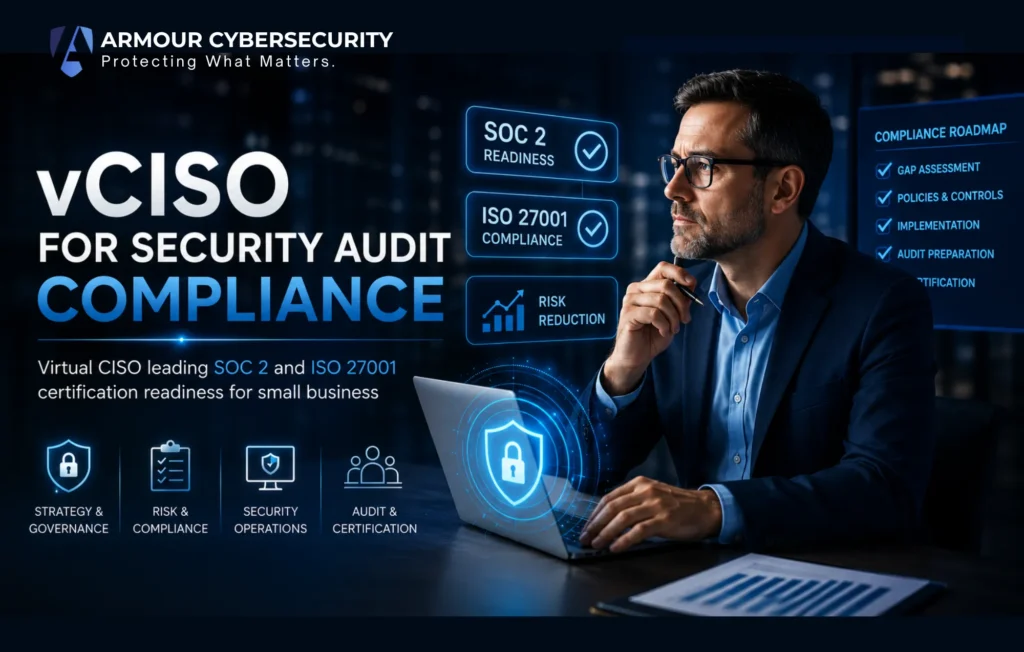
Quick answer: A vCISO for security audit compliance provides the executive ownership that SOC 2, ISO 27001, HIPAA, and PCI DSS auditors require. The vCISO drives readiness year-round, owns the auditor relationship, ensures controls are documented and evidenced, and presents findings to leadership. Without that role filled, audits stall, certifications lapse, and compliance becomes a fire drill.
Key Takeaways
- SOC 2, ISO 27001, HIPAA, PCI DSS, and CMMC all require demonstrable executive ownership of the security program.
- Most SMBs approach audits reactively, scrambling to assemble documentation under deadline pressure. A vCISO makes audit readiness an ongoing state, not an event.
- The vCISO owns the auditor relationship, responds to findings, and commits the organization to remediation timelines with executive authority.
- A vCISO reduces the total cost of compliance by building the program once, correctly, rather than rebuilding it before each audit cycle. vCISO services from Armour Cybersecurity are structured around this continuous readiness model.
- For businesses pursuing certification to win enterprise customers, a vCISO closes the credibility gap faster than any other single investment.
Cybersecurity Compliance for Small Business: Why Most SMBs Struggle With Audits
Security audits are designed to evaluate whether an organization has a mature, governed security program. They assess whether risks are identified and managed, whether controls are documented and operating effectively, whether policies are current and enforced, and whether leadership takes accountability for security outcomes.
The problem for most SMBs is that none of those things exist in a form auditors can assess. Security is managed informally, often by IT staff who are doing their best without dedicated expertise or executive mandate. Policies were written once and never updated. Risk decisions are made reactively. And when the auditor asks who owns the program, the answer is unclear.
That gap is not primarily a technology problem. The tools many SMBs use are adequate. The problem is governance: the absence of executive leadership that defines what the program must achieve, ensures it operates consistently, and documents everything in a form that satisfies external scrutiny. A cybersecurity posture assessment often reveals exactly how wide this gap is.
What Do Auditors Actually Look For?
Understanding what drives audit outcomes helps explain why executive leadership is so determinative. Regardless of the specific framework, auditors evaluate a consistent set of organizational attributes.
Defined ownership and accountability
Every control in a security framework requires an identified owner. That person or role is accountable for the control operating as designed, for monitoring its effectiveness, and for remediating failures. When ownership is ambiguous or distributed across staff members without clear authority, auditors flag it as a governance deficiency. A vCISO provides the executive ownership that satisfies this requirement across the entire control environment.
Current and enforced policies
Auditors review policy documents and then test whether they reflect how the organization actually operates. A password policy that says accounts must use multi-factor authentication is worthless if half the accounts do not. The vCISO owns the policy library, ensures policies are current, and drives enforcement through the governance, risk and compliance structure they establish.
Risk management evidence
Frameworks like SOC 2 and ISO 27001 require documented risk assessments, a risk register, and evidence that identified risks are being managed. Auditors look for a structured, repeatable process, not a one-time exercise done before the audit. The vCISO maintains the risk register as a living document and conducts quarterly reviews that produce the evidence auditors expect.
Audit trail and control evidence
Technical controls need to produce logs, reports, and evidence that they operated correctly during the audit period. This requires knowing what evidence is needed before the period begins, not after. A vCISO working year-round ensures the right evidence is being captured continuously, so audit preparation is a matter of organizing existing documentation rather than recreating it retroactively.
How Does a vCISO Drive Certification Readiness?
The Armour Cybersecurity virtual CISO engagement approaches compliance as a continuous program state, not a point-in-time event. This distinction is what separates organizations that achieve and maintain certification from those that pass once and scramble again the following year.
Gap assessment and remediation roadmap
The engagement begins with a structured review of your current security posture against the target framework. A compliance readiness assessment produces a gap analysis with prioritized remediation items, ownership assignments, and a timeline that builds toward certification rather than toward an audit date. This gives leadership a clear picture of where the program stands and what it takes to close the distance.
Year-round evidence management
A vCISO ensures that evidence generation is built into how the program operates. Monthly monitoring reports, quarterly risk reviews, access reviews, vulnerability scan results, training completion records, and incident logs are all produced and retained as a matter of routine. When the auditor requests documentation for the prior 12 months, it exists because the program was designed to produce it.
Auditor relationship management
The vCISO owns the auditor relationship directly. They manage pre-audit communications, respond to information requests, explain the organization’s risk decisions, and present remediation plans for prior findings. This is a role that requires executive standing and security expertise. Having a senior leader represent the organization to auditors rather than deflecting questions to IT staff changes the tone and outcome of the audit.
Findings response and remediation tracking
Audit findings require an owner who can commit the organization to remediation timelines and follow through on those commitments. The vCISO takes ownership of findings, assigns remediation responsibility, tracks closure, and communicates progress to auditors and leadership. This turns findings into a managed process rather than an unresolved liability that grows between audit cycles.
Which Compliance Frameworks Does a vCISO Support?
Armour Cybersecurity vCISOs build programs against the frameworks most relevant to SMBs:
Virtual CISO for SOC 2 Certification
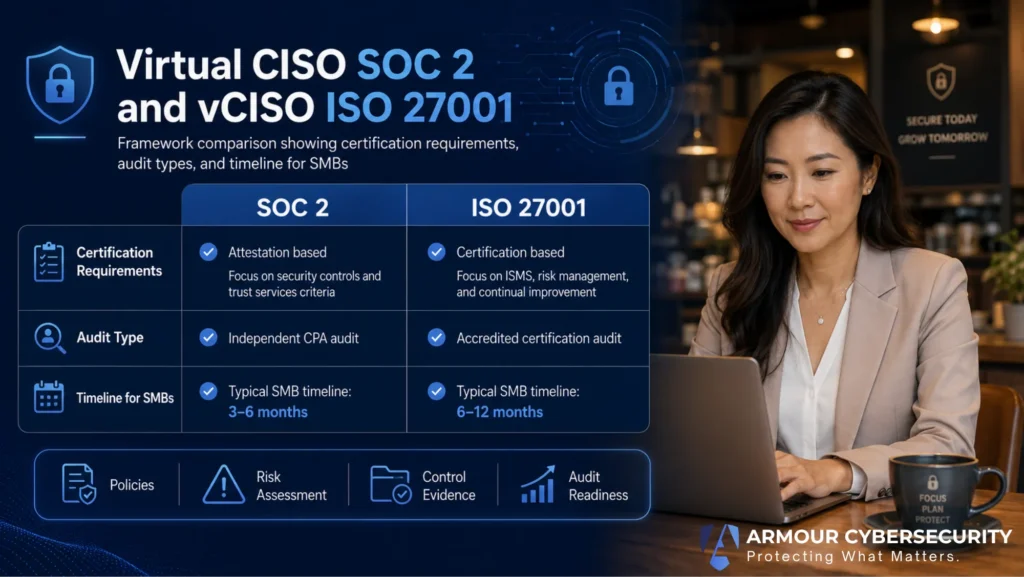
SOC 2 Type I and Type II for technology companies and service providers with customer data obligations. The vCISO drives readiness across all five trust service criteria: security, availability, processing integrity, confidentiality, and privacy. Type I assesses control design at a point in time; Type II assesses operating effectiveness over a defined period, typically 12 months. Armour Cybersecurity’s integrated compliance audit program supports multi-framework readiness including SOC 2.
vCISO for ISO 27001 Certification
ISO 27001 is the internationally recognized standard for information security management systems, widely required by European and global enterprise buyers. The vCISO builds the ISMS documentation, drives Annex A control implementation, and manages the Stage 1 and Stage 2 audit process through to certification.
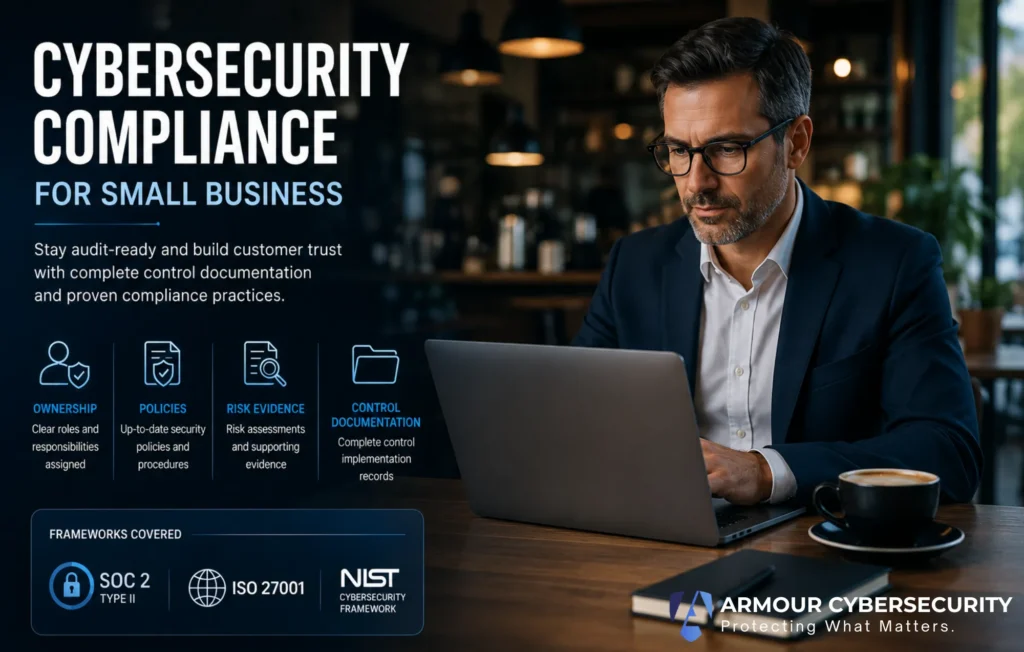
HIPAA, PCI DSS, CMMC, and NIST CSF
For healthcare practices and business associates, the vCISO drives HIPAA Security Rule compliance and manages breach notification obligations. For businesses processing payment card data, PCI DSS readiness and SAQ completion. For defense contractors, CMMC Level 2 certification readiness. And for organizations building or maturing a security program without a specific certification requirement, the NIST Cybersecurity Framework and CIS Controls provide the governance structure. A strong security strategy and roadmap underpins all of these frameworks.
Most engagements involve multiple frameworks. A healthcare technology company may need SOC 2 for enterprise customers, HIPAA for its data obligations, and NIST CSF as the underlying governance structure. The vCISO designs the program to satisfy all applicable requirements without duplicating effort.
What Happens Without Executive Security Leadership During an Audit?
The consequences of approaching an audit without a vCISO in place are predictable. The audit consumes disproportionate internal resources as staff scramble to assemble documentation they were never systematically collecting. Controls that work in practice fail to produce the evidence auditors require. Risk decisions made informally and without documentation cannot be defended. And the audit either fails, produces findings that damage customer and investor confidence, or results in a limited certification that does not satisfy enterprise buyers.
Beyond the immediate audit outcome, the absence of executive leadership means the program does not improve between cycles. The same findings recur. The same scramble happens the following year. And the certification, even when achieved, reflects a program that is managed for the audit rather than for the business. For organizations that have experienced this cycle, engaging a vCISO alongside a managed security service breaks the pattern by establishing both governance and operational execution.
Security audits test whether your program has executive ownership. If the answer is unclear, the audit outcome is predictable. A vCISO from Armour Cybersecurity provides the leadership, governance, and auditor-ready evidence that SOC 2, ISO 27001, and HIPAA require, so compliance becomes a program state, not an annual fire drill.
Explore vCISO Services for Audit Readiness
Contact the Armour Cybersecurity team at armourcyber.io/vciso-services to discuss certification readiness for your organization.
Frequently Asked Questions
How long does it take to get SOC 2 certified with a vCISO?
Timeline depends on where the program is today and which SOC 2 type is the target. SOC 2 Type I, which reflects the design of controls at a point in time, can typically be achieved in three to six months from a standing start. Type II, which reflects operating effectiveness over a defined period, typically 12 months, requires the audit period to complete before the report is issued. A vCISO drives readiness so the organization enters the audit period with controls already operating correctly.
Can a vCISO help us respond to a customer security questionnaire?
Yes. Responding to customer security questionnaires is one of the most immediate practical benefits of a vCISO engagement. The vCISO owns the response, ensures answers reflect a real and defensible program, and provides the level of detail enterprise buyers expect from a senior security executive rather than an IT generalist.
What is the difference between SOC 2 and ISO 27001?
SOC 2 is an audit framework primarily used in North America, produced by the AICPA, that evaluates controls across five trust service criteria: security, availability, processing integrity, confidentiality, and privacy. ISO 27001 is an international standard for information security management systems, widely recognized in Europe and required by many global enterprise buyers. Both certify security program maturity; the right choice depends on your market and customer requirements. Many organizations pursue both.
Does a vCISO engagement include the audit itself?
The vCISO drives readiness and owns the auditor relationship, but the certification audit itself is conducted by an independent third-party auditor or assessor. The vCISO manages the engagement with that auditor on your behalf, represents the organization during the audit, and coordinates the response to findings. Having a documented breach response capability also strengthens the audit posture.
What if we already have partial compliance documentation?
Most organizations beginning a vCISO engagement have some existing documentation. The gap assessment at the start of the engagement reviews what exists, identifies what is current and useful, and flags what needs to be replaced, updated, or created from scratch. Existing work is preserved where it is valid.
About David Chernitzky
David Chernitzky brings over 25 years of deep cybersecurity and military cyber intelligence experience, with a career rooted in strategic risk management and protecting critical systems against advanced threats. As CEO and Co-Founder of Armour Cybersecurity, he combines strategic vision with hands-on expertise to deliver practical, high-impact cyber defense solutions.