Quick answer: A virtual CISO for small business is a senior cybersecurity executive who leads your security program on a flexible, part-time basis. Small businesses need one when security decisions are being made without executive ownership, when audits or certifications require formal security leadership, or when the gap between what the business faces and what IT can handle has grown too wide to ignore.
Key Takeaways
- A vCISO provides the same executive-level security leadership a full-time CISO would, on a schedule and budget that fits your organization.
- Most growing businesses need senior security leadership long before they can justify a full-time CISO salary.
- Common triggers for engaging a vCISO include audit pressure, customer security requirements, M&A due diligence, and post-incident program rebuilds.
- A vCISO owns strategy, governance, risk and compliance, board reporting, and incident command, freeing your IT team to focus on operations.
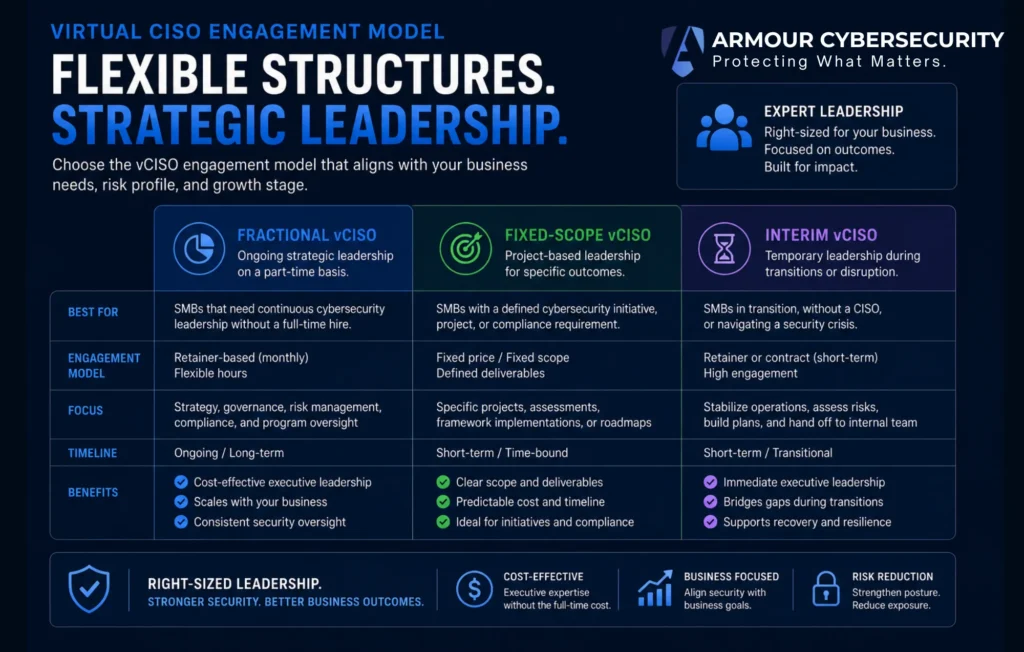
- The right engagement structure depends on where your organization is today. vCISO services are built to scale with your business.
What Is a vCISO?
A Virtual Chief Information Security Officer is a senior cybersecurity leader who operates as an integrated member of your executive team without being a full-time employee. The vCISO owns your security program: strategy, governance, risk management, compliance, executive reporting, and incident command. The role carries the same authority and scope as a traditional CISO, structured around the engagement model your business actually needs.
That distinction matters. A vCISO is not a consultant who delivers a report and leaves. They are an ongoing security executive who shows up in your leadership meetings, presents to your board, answers your auditor’s questions, and makes decisions on behalf of the business within an agreed structure. The engagement is fractional in time, not in responsibility.
For most small and mid-sized businesses, this model solves a genuine problem. The cost of a full-time CISO, salary, benefits, and equity for an experienced hire typically runs from $250,000 to $400,000 annually before bonuses. The organizations that need senior security leadership the most are often the ones least positioned to absorb that cost.
vCISO Services: What Does a Virtual CISO Actually Do?
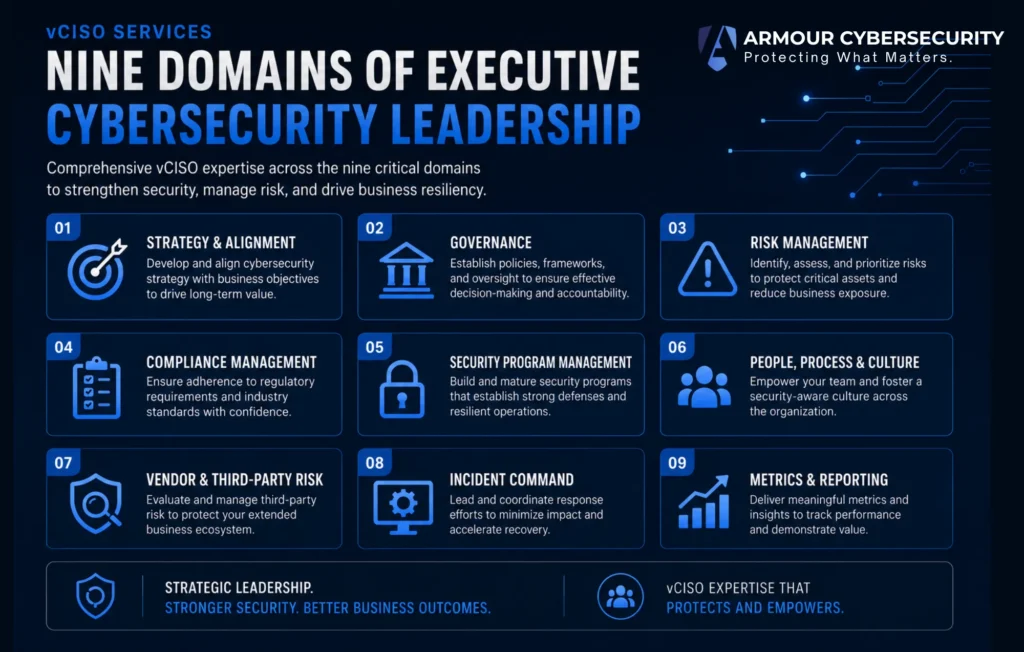
The scope of a vCISO engagement covers the nine domains a mature security program requires at the executive level.
Security strategy and roadmap
The vCISO develops a multi-year security strategy and roadmap aligned to your business objectives and risk appetite. This is not a list of tools to buy. It is a prioritized roadmap with milestones, ownership, and budget guidance that translates where the business is going into what the security program needs to support it.
Governance and policy
Most SMBs have security policies that are either nonexistent, outdated, or lifted from a template with no connection to how the business actually operates. The vCISO establishes the governance structure, builds or modernizes the policy library, and defines how security decisions get made and escalated across the organization.
Risk management
The vCISO maintains the organizational risk register: a living document of identified risks with likelihood, impact, ownership, and residual risk after compensating controls. Quarterly risk reviews keep leadership informed about what has changed and what requires action. A formal cybersecurity posture assessment often serves as the foundation for this work.
Compliance and audit leadership
For businesses operating under SOC 2, ISO 27001, HIPAA, PCI DSS, or CMMC, the vCISO owns the relationship with external auditors and regulators. They drive certification readiness, respond to audit findings, and ensure the security program produces the evidence auditors expect, rather than scrambling to assemble documentation under deadline pressure.
Executive and board reporting
The board needs to understand cyber risk in business terms. The vCISO translates technical findings into the language leadership expects: risk exposure, program maturity, incidents, regulatory posture, and strategic priorities. Quarterly board briefings and audit committee materials are core deliverables of every engagement.
Incident command
When an incident occurs, the vCISO activates a pre-defined response structure with executive decision authority. They coordinate the response, manage escalation, communicate with leadership and legal counsel, and ensure the organization responds in a way that limits damage and satisfies legal and regulatory obligations. Having a breach response capability in place before an incident occurs is essential to this function.
How Is a vCISO Different from an IT Manager?
This is one of the most common questions SMB owners ask when they first encounter the vCISO concept. The distinction is significant, and it matters because confusing the two roles is how security programs fail.
Your IT manager, or the person playing that role, keeps the lights on. They manage infrastructure, support end users, maintain systems, and ensure the technology that runs the business keeps running. That is a full-time responsibility for most SMBs, and it is what the role is actually occupied doing.
Security at the executive level requires a different skill set, a different perspective, and a different level of authority. Governance decisions, board-level risk reporting, audit relationships, regulatory compliance strategy, and incident command are not IT functions. They require someone who understands both the technical landscape and the business context, and who has the executive standing to make decisions that affect the whole organization.
A vCISO does not replace your IT team. It gives the security function its own executive ownership so your IT team can focus on what they are actually equipped to do.
Do I Need a CISO? Signs Your Small Business Needs Executive Security Leadership
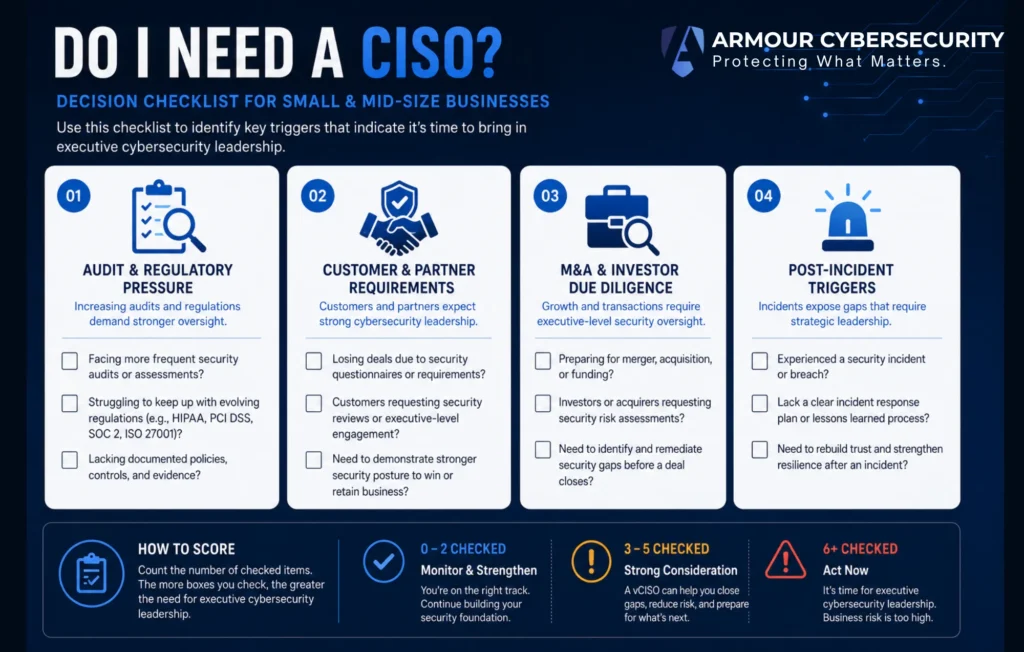
The clearest signal that an organization needs a vCISO is when security decisions are being made without anyone qualified to make them. That can take several forms.
If your business is approaching a SOC 2, ISO 27001, or HIPAA audit and no one owns the program being audited, you need security leadership before the auditor arrives. Certification requires an executive who can demonstrate ownership of the control environment, answer for program decisions, and commit the organization to remediation timelines. A compliance readiness assessment can establish where the gaps are before the audit begins.
If enterprise customers or partners are sending security questionnaires and the responses are coming from IT staff who are guessing at the answers, you are losing deals. Large buyers evaluate supplier security before signing contracts, and a weak or inconsistent response is a reason to walk. A vCISO owns those responses and ensures they reflect a real, defensible program.
If your business is preparing for investment, acquisition, or a capital raise, security governance is a due diligence item. Investors and acquirers look for executive security ownership as a signal of organizational maturity. A vCISO closes that gap and documents the program in a way that holds up to scrutiny.
If your organization has experienced a breach, ransomware event, or significant near-miss and the root cause was an absence of governance, the answer is not more tools. It is leadership. A vCISO builds the program that should have been in place, with the accountability structure to keep it there. For more on how Armour Cybersecurity structures virtual CISO engagements, visit armourcyber.io/vciso-services.
Security decisions without security leadership is how programs fail. A virtual CISO gives your business the executive ownership, governance structure, and board-ready reporting that auditors, investors, and enterprise customers expect, without the cost of a full-time hire.
Explore vCISO Services from Armour Cybersecurity
Contact the Armour Cybersecurity team at armourcyber.io/vciso-services to discuss the right engagement model for your organization.
Frequently Asked Questions
What is the difference between a vCISO and a managed security service?
A managed security service handles the technical execution of your security controls: monitoring, detection, response, and vulnerability management. A vCISO operates at the strategic and governance layer: security strategy, risk management, board reporting, compliance leadership, and incident command. Many organizations use both together, with the vCISO providing leadership and the managed service handling operational execution.
How much does a vCISO cost compared to a full-time CISO?
A full-time CISO at an experienced level typically costs $250,000 to $400,000 annually in total compensation. A fractional vCISO engagement costs a fraction of that, scaled to the cadence the organization actually needs. Exact pricing depends on scope, engagement structure, and the size and complexity of the program.
Can a vCISO present to our board?
Yes. Board reporting, audit committee briefings, and direct representation to external auditors and regulators are core parts of a vCISO engagement. The vCISO prepares board-ready materials, attends meetings as the organization’s security executive, and ensures leadership has the information they need to make informed risk decisions.
How long does a vCISO engagement last?
Engagements are structured to your needs. Some organizations engage a vCISO on an ongoing fractional basis with no defined end date. Others use a fixed-scope program built over 12 to 18 months to establish governance and achieve certification, then transition to a lighter advisory retainer. Interim CISO engagements during a leadership search are typically three to six months.
Will the vCISO work with our existing IT team?
Yes, and this is by design. The vCISO operates as an executive integrated with your team, providing strategy, governance, and leadership while your IT staff continue running operations. The goal is to amplify what your team already does well, not to replace or override it. The vCISO handles the security decisions your IT team is not positioned to make, and leaves operations in capable hands.
About David Chernitzky
David Chernitzky brings over 25 years of deep cybersecurity and military cyber intelligence experience, with a career rooted in strategic risk management and protecting critical systems against advanced threats. As CEO and Co-Founder of Armour Cybersecurity, he combines strategic vision with hands-on expertise to deliver practical, high-impact cyber defense solutions.