By David Chernitzky, CEO, Armour Cybersecurity · Serving Toronto and organizations across North America · Last updated August 25, 2026
Quick Answer
Online gaming and sportsbook platforms are under continuous automated attack from organized criminal groups running credential stuffing, account takeover, and bonus abuse operations. These are not unsophisticated attacks. They are industrialized fraud operations with purpose-built tools calibrated to specific platform behaviours. The financial losses are direct, the regulatory exposure is real, and generic security controls are not sufficient to stop them.
Key Takeaways
- Credential stuffing attacks against iGaming platforms use breach data from unrelated sites to access player accounts at scale, enabling fund theft and identity fraud.
- Bonus abuse operations create synthetic accounts or compromise real ones to claim promotional offers repeatedly, directly eroding operator margin.
- Payment fraud on gaming platforms uses compromised payment credentials to fund accounts, then withdraws through a separate method to launder funds.
- Organized fraud groups share platform-specific intelligence, meaning a vulnerability exploited against one operator is tested against others within days.
- Fraud controls built into the platform architecture, combined with threat intelligence and managed detection, are more effective than perimeter security alone.
Why Are iGaming Platforms Such a Consistent Fraud Target?
Online gaming platforms convert deposited funds into account balances, enable gameplay, and pay out winnings, all through automated processes that operate continuously and at scale. From a fraud perspective, this creates a pipeline that accepts money in, processes it against game outcomes, and pays it out, with multiple points at which fraudulent activity can generate real financial return.
The competitive requirement for rapid account opening and deposit processing, driven by the dynamics of the iGaming market, creates friction with the verification controls that would stop many fraud patterns. An operator that requires extensive identity verification before allowing a first deposit loses players to competitors with faster onboarding. The balance between user experience and fraud prevention is a defining challenge for iGaming operators.
Organized fraud groups understand the economics of iGaming platforms better than most operators expect. They study terms and conditions for bonus structures, test authentication mechanisms for weaknesses, identify payment processor integrations with exploitable configurations, and share that intelligence across criminal networks. An operator that patches a vulnerability has typically bought weeks, not months, before the next attempt.
How Does Credential Stuffing Work Against Gaming Accounts?
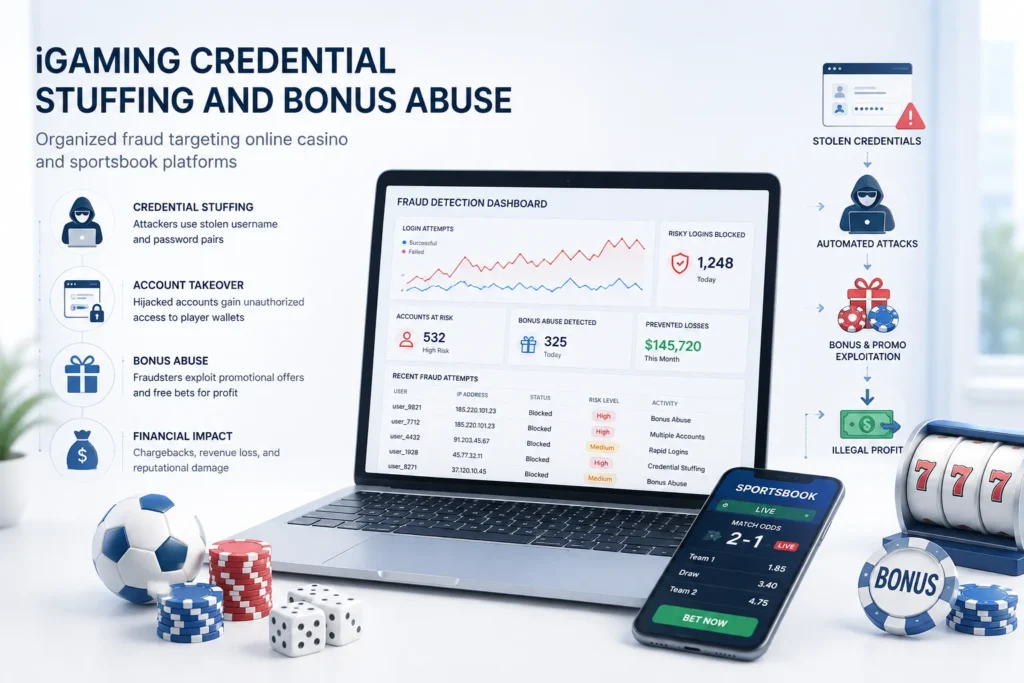
Credential stuffing uses automated tools to test username and password combinations from breach databases against online gaming login pages. The breach data does not need to come from the gaming operator itself. Credentials from breached retail accounts, social media platforms, or other consumer services are tested against gaming platforms because many players reuse the same email and password combination across multiple services.
Tools used for gaming platform credential stuffing are purpose-built for the sector. They include logic to handle CAPTCHAs through third-party solving services, rotate IP addresses through residential proxy networks to avoid velocity-based blocking, simulate realistic browser behaviour to avoid bot detection, and cache results to identify valid credentials efficiently. Running a credential stuffing campaign against a major iGaming platform requires minimal technical skill and is available as a commercial fraud service on criminal markets.
A successful credential stuffing hit gives the attacker authenticated access to the player’s account with their existing balance, stored payment methods, and identity verification status. From there, the attacker can withdraw available funds, add new payment methods for withdrawal, use stored payment credentials for other fraudulent purposes, or sell the verified account on criminal markets where accounts with completed KYC verification carry a premium.
What Is Bonus Abuse and How Does It Scale?
Synthetic Account Creation
Welcome bonuses and promotional offers that apply to new account registrations create an incentive for attackers to create large numbers of fake accounts to claim the bonus repeatedly. Synthetic account creation uses generated or stolen identity information to pass KYC verification at scale. The quality of KYC controls determines how many synthetic accounts can be successfully created before detection, and operators with weaker identity verification are systematically targeted.
The economics are straightforward: if a welcome bonus is worth $100 per new account and a synthetic account costs $5 to create through a fraud-as-a-service provider, the operation is profitable as long as the success rate is above five percent. At the scale that automated operations run, even a low success rate generates significant returns.
Multi-Account Bonus Exploitation
Players who create multiple accounts in violation of platform terms to claim bonuses repeatedly represent a related but distinct fraud pattern. Unlike fully synthetic operations, multi-account abuse often involves real players who understand the platform well enough to evade the device fingerprinting and identity checks that operators use to detect duplicate accounts. Device emulation tools and identity rotation make detection harder, and the insider knowledge of bonus terms means exploitation is targeted and efficient.
Matched Betting and Arbitrage Abuse
Sportsbook operators face bonus abuse patterns specific to their product. Matched betting operations use free bets and enhanced odds promotions to lock in guaranteed returns by placing opposing bets across multiple accounts or platforms. At individual scale, matched betting is arguably legal consumer behaviour; at industrial scale, using automation and multiple accounts to systematically extract promotional value, it is abuse that directly erodes operator margin and distorts the economics of promotional budgets.
How Does Payment Fraud Operate on Gaming Platforms?
Gaming platforms are useful to payment fraud operators because they provide a mechanism to convert compromised payment credentials into withdrawable funds. An attacker with stolen credit card or bank account details funds a gaming account using those credentials, plays through a minimal amount, and then requests withdrawal to a different payment method they control. The gaming platform becomes a laundering mechanism.
Operators are liable for chargebacks when compromised payment credentials are used to fund accounts. A high chargeback rate damages the operator’s relationship with payment processors and can result in loss of payment processing facilities. AML regulatory exposure is also triggered when gaming platform payment flows show patterns consistent with laundering.
The controls that stop payment fraud on gaming platforms, velocity limits on deposits and withdrawals, device and behavioural analysis, linking of deposit and withdrawal methods, and real-time transaction monitoring, are the same controls that support AML compliance. Building them as an integrated capability rather than separate fraud and compliance functions is more effective and more efficient.
What Controls Are Most Effective Against These Threats?
Phishing-resistant multi-factor authentication on player accounts eliminates the value of credential stuffing hits. A valid email and password combination cannot access an account protected by an authenticator app or hardware token. The adoption challenge is real, but operators that offer MFA and incentivize its use meaningfully reduce their account takeover exposure.
Behavioural analytics and device intelligence detect automated attack patterns that volume and velocity controls alone miss. A credential stuffing campaign that carefully throttles its request rate to avoid velocity triggers is visible in the device and behavioural signals it generates: identical browser fingerprints across thousands of login attempts, impossible geographic transitions between sessions, and login timing patterns that match tool behaviour rather than human behaviour.
KYC controls calibrated to detect synthetic identity creation, including document verification with liveness detection and cross-reference against identity databases, raise the cost of synthetic account creation to the point where low-margin bonus abuse operations become unprofitable. The investment in stronger KYC reduces both bonus abuse losses and AML regulatory exposure simultaneously.
Finally, threat intelligence specific to the gaming sector provides early warning of campaigns targeting the operator’s platform. Criminal forums discuss platform-specific vulnerabilities, share working credential lists, and sell access to accounts with completed KYC. Monitoring for mentions of the operator’s brand and platform in these channels provides intelligence that allows preventive action before campaigns reach full scale, and Armour builds this into a gaming cybersecurity programme rather than treating it as a bolt-on.
Across the 260+ organizations Armour Cybersecurity protects in 52+ industries, the iGaming operators who keep fraud losses flat while they grow are the ones who stopped running fraud and AML as two teams looking at the same data. They wired player-account security, device and behavioural signals, KYC, and transaction monitoring into one capability, so a credential-stuffing wave, a bonus-abuse ring, and a laundering pattern surface as related signals on one screen rather than three separate investigations that never quite connect.
Frequently Asked Questions
How do we know if our platform is currently being credential stuffed?
The signals include elevated failed login rates from IP ranges associated with proxy or VPN services, login attempt timing patterns inconsistent with human behaviour, spikes in password reset requests, and increases in account access from new devices or locations following a third-party breach announcement. Armour’s threat intelligence service monitors for credential exposure and dark web discussion of gaming platform attack campaigns, providing early warning before these signals become visible in platform logs.
At what scale does bonus abuse become a material financial risk?
Bonus abuse at individual scale, one player gaming a promotion, is an acceptable cost of doing business. At automated scale, where hundreds or thousands of synthetic accounts systematically exploit every promotion, the cumulative loss against a single promotion campaign can reach six figures for a mid-size operator. More significantly, the data distortion from bonus abuse inflates player acquisition metrics, distorting the economics of the promotional budget and making it harder to assess the genuine return on marketing spend.
Do fraud controls affect the experience for legitimate players?
Poorly designed fraud controls create friction for legitimate players without meaningfully stopping sophisticated attackers who adapt to controls quickly. Well-designed controls operate transparently for legitimate players while creating friction for automated attack patterns. Risk-based authentication that adds verification steps only when signals indicate elevated risk, rather than applying the same friction to every login, achieves this balance. Armour’s approach to iGaming security prioritizes controls that are effective against the actual threat while preserving the user experience that drives player retention.
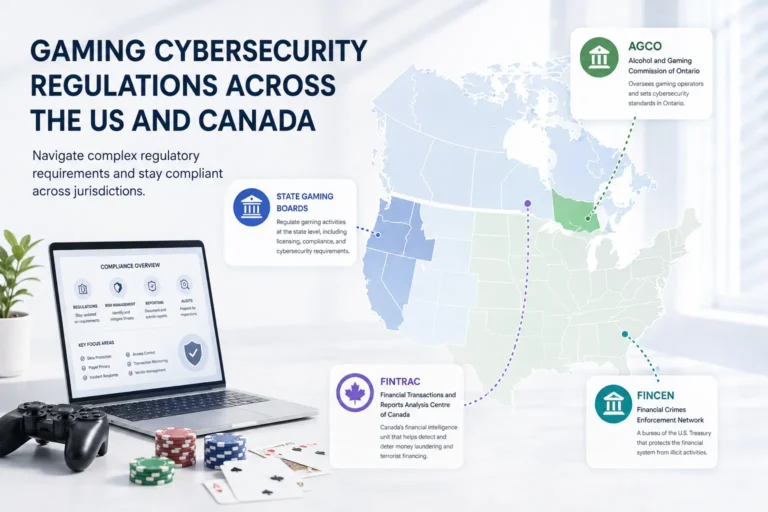
Can fraud controls also help with FINTRAC and FinCEN AML compliance?
Yes. The transaction monitoring, patron identity verification, and audit logging that AML compliance requires are built on the same data and systems as fraud controls. An integrated approach, where fraud detection and AML monitoring share patron behaviour data and transaction intelligence, is more effective than separate systems operating on the same data independently. Armour’s gaming cybersecurity programme treats AML technology integrity as a component of the overall security programme, not a separate compliance track.
The Bottom Line
Credential stuffing, bonus abuse, and payment fraud against iGaming and sportsbook platforms are not nuisance-level problems; they are industrialized operations run by groups that understand the platform economics and share what works. The losses are direct, and because the same money flows feed AML reporting, a fraud problem is a compliance problem too. Perimeter security does not stop any of it. What works is fraud resistance built into the platform, phishing-resistant MFA, behavioural and device analytics, liveness-checked KYC, and gaming-specific threat intelligence, run as one capability that also serves AML. Armour Cybersecurity helps iGaming operators and sportsbooks build gaming cybersecurity programme coverage that reduces credential stuffing, bonus abuse, and payment fraud while protecting the player experience, so growth does not come with a proportional rise in fraud losses and regulatory exposure.
About the author
David Chernitzky is the CEO and Co-Founder of Armour Cybersecurity, a Toronto-based firm that protects organizations across North America from advanced cyber threats. He brings more than 25 years of cybersecurity and military cyber intelligence experience, having served as an officer in an elite technology unit before co-founding Armour. Armour’s team of military-intelligence veterans and senior advisors serves 260+ clients across 52+ industries with a 97% client retention rate. Learn more about Armour Cybersecurity.