By David Chernitzky, CEO & Co-Founder, Armour Cybersecurity · Toronto-based, serving organizations across North America · Last updated July 30, 2026
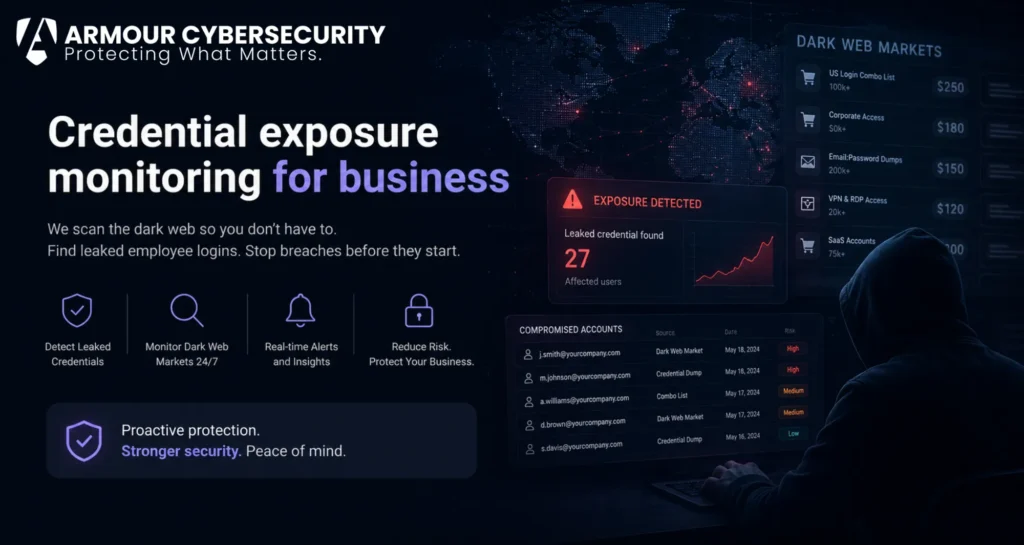
Quick answer: Credential exposure monitoring for business is the continuous scanning of dark web markets, breach databases, and underground forums for your employees’ stolen logins. Credential theft is one of the most common ways attackers first get into a business of any size. Usernames and passwords taken through phishing, malware, and third-party data breaches circulate in these markets, often for months before they are used. Monitoring detects the leak early and gives you time to act before attackers do.
Key Takeaways
- Stolen credentials are the top way attackers break into a network. They are behind 88% of basic web application attacks, according to the Verizon 2025 Data Breach Investigations Report.
- Credentials stolen through phishing or third-party breaches typically appear on underground marketplaces within days to weeks of the original compromise.
- Without active monitoring, most organizations only discover credential exposure when an attacker uses the credentials, which may be months later.
- The window between credential exposure and use is the window to act: forcing resets, enabling multi-factor authentication, and reviewing access logs.
- Credential monitoring is not limited to your own breach. Third-party services your employees use with corporate email addresses are a major source of exposure.
How Do Employee Credentials End Up on the Dark Web?
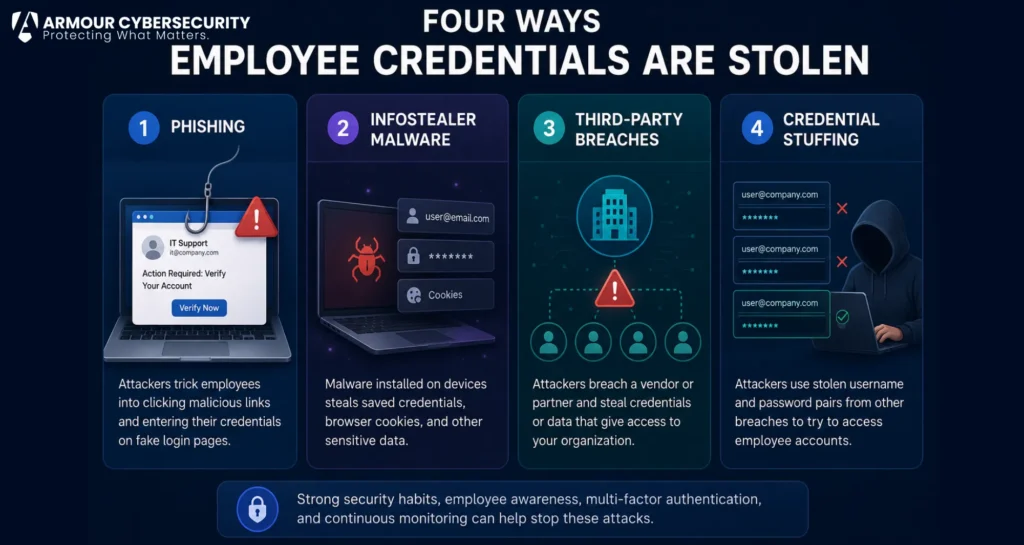
Credential theft happens through several distinct pathways, and understanding them explains why credential exposure is so widespread, even in organizations with reasonable security practices.
Phishing
Phishing emails that direct employees to convincing fake login pages harvest credentials directly. The employee enters a username and password believing they are accessing a legitimate service. The attacker collects the credentials, which may then be used immediately or sold to other threat actors through underground credential markets. Phishing campaigns targeting corporate email addresses are sophisticated enough to evade basic email filters and convincing enough to fool employees who receive dozens of legitimate login requests per week. Regular security awareness training is one of the few controls that measurably lowers the click rate over time.
Infostealer malware
Infostealer malware installed on an employee device extracts credentials stored in browsers, password managers, and application sessions. A single infostealer infection can yield credentials for every service the employee has logged into on that device: corporate email, cloud applications, VPN, banking, and personal accounts. These credential packages, often called logs, are sold in bulk on underground markets. The price per log varies by the value of the accounts included, with corporate email and financial service credentials commanding premium prices.
Third-party data breaches
When an external service is breached, the credentials of every user of that service are exposed. If your employees use corporate email addresses to register for third-party services, those credentials may surface in breach databases when the external service is compromised. This is a significant source of corporate credential exposure because it is entirely outside the organization’s control and often involves services that IT does not formally manage.
Credential stuffing
Attackers take credential lists from one breach and test them against other services, knowing that many people reuse passwords. An employee who uses the same password for a personal service and their corporate email creates a direct exposure path when the personal service is breached. Credential stuffing attacks test millions of username and password combinations against corporate login pages automatically.
What Happens to Credentials After They Are Stolen?
The lifecycle of stolen credentials varies by value and attacker sophistication. High-value credentials, those associated with financial systems, administrative accounts, or organizations with known strategic value, may be used immediately or sold quickly to buyers with specific targeting in mind.
More commonly, credentials enter the underground economy and circulate through several stages before use. Initial access brokers collect and sell large volumes of credentials with minimal vetting. Buyers test credentials against target services to identify which are still valid. Valid credentials for high-value targets are then either used directly or re-sold at a premium to threat actors planning specific campaigns.
The window between initial theft and active use commonly spans weeks to months. This interval is the opportunity that credential exposure monitoring provides. An organization that detects credential exposure within days of the original leak can force password resets and enable multi-factor authentication before the credentials are actively used to access company systems.
Why Is Detection So Difficult Without Active Monitoring?
Credential marketplaces and the forums where stolen data is traded are not accessible through standard web browsing. They operate on dark web networks that require specific tools and knowledge to access, and the communities themselves have anti-surveillance measures that make automated monitoring technically demanding.
Even where data surfaces on more accessible channels, such as paste sites and public breach databases, the volume is enormous. Hundreds of millions of credentials appear in public breach databases. Identifying which of those credentials belong to current employees of your organization requires matching corporate email domains against breach data at scale, then validating that the accounts are active and the passwords are likely still in use.
This is the function that CTI credential monitoring performs. The monitoring infrastructure accesses underground sources that are not reachable through standard security tools, matches findings against your organization’s monitored domains and accounts, and routes validated findings to analysts who confirm relevance and escalate with remediation guidance. The result is specific, actionable intelligence rather than a raw data feed that requires a team to interpret.
What Should Your Business Do When Credentials Are Found?
The response to a credential exposure finding follows a defined sequence that limits the window of opportunity for attackers.
- Force immediate password resets for all affected accounts, including any other accounts where the same password may have been used.
- Review access logs for the affected accounts going back 30 to 90 days for signs of unauthorized access that occurred before the exposure was detected.
- Enable or enforce multi-factor authentication on all affected accounts if not already in place. Credentials alone become far less useful to an attacker when MFA is required.
- Assess whether the compromised credentials had access to sensitive systems, administrative functions, or financial processes that warrant broader investigation.
- Notify affected employees with guidance on password hygiene and the specific risk that arose from the exposure.
Armour’s cyber threat intelligence service delivers credential exposure findings with the affected accounts identified, the source documented, and recommended remediation steps included. Escalation happens immediately for critical findings, so the response can begin within hours of exposure being detected. Armour is a Toronto-based firm serving small and midsize businesses across North America, and where an exposure has already been used to get in, the same team moves straight into incident response.
Does Multi-Factor Authentication Eliminate Credential Risk?
Multi-factor authentication significantly reduces the risk that stolen credentials will be used successfully to access corporate accounts, but it does not eliminate credential exposure risk entirely. Attackers have developed techniques to bypass MFA, including real-time phishing that harvests both credentials and MFA tokens simultaneously, SIM swapping attacks that redirect SMS-based MFA codes, and MFA fatigue attacks that bombard users with authentication requests until one is accepted by accident.
MFA is a critical control and should be enforced on all corporate accounts. It reduces the value of stolen credentials substantially. But credential exposure monitoring remains important even in environments with strong MFA enforcement, because credential exposure provides intelligence about attack intent, targeted accounts, and the methods being used to compromise your organization, all of which inform the broader security response beyond a single password reset.
Frequently Asked Questions
How do I know if my business credentials are already on the dark web?
The most reliable way to find out is through active credential exposure monitoring. Free tools such as Have I Been Pwned can identify whether specific email addresses appear in known public breach databases, but they do not cover underground marketplaces, fresh credential logs, or private breach data. A managed CTI service monitors these sources continuously and provides validated findings specific to your organization’s domain.
What is an infostealer and how does it get onto employee devices?
An infostealer is malware specifically designed to extract credentials, browser data, session cookies, and other sensitive information from infected devices. Infostealers are commonly distributed through phishing emails with malicious attachments, fake software downloads, malvertising, and compromised websites. Because they are designed to operate silently and extract data quickly, many infections are not detected by standard antivirus software before the data has already been exfiltrated.
Are credentials for cloud services like Microsoft 365 targeted specifically?
Yes, significantly so. Microsoft 365 and Google Workspace credentials are among the most valuable in underground markets because a single set of credentials provides access to email, files, calendars, contacts, and often connects to other business systems through single sign-on. Business email compromise fraud, which caused over $2.9 billion in reported losses in 2023 according to FBI data, relies primarily on compromised Microsoft 365 and similar cloud credentials.
How far back does credential monitoring look?
Monitoring is ongoing and forward-looking, but the initial deployment phase typically includes a retroactive check against available historical breach data and known credential databases to identify existing exposures. This baseline assessment often surfaces credentials that were compromised in prior third-party breaches and have been circulating without the organization’s knowledge.
What if an exposed credential belongs to a former employee?
Former employee credentials that are still active in company systems represent an active risk and should be treated as a priority finding. Offboarding processes that leave accounts active, even with changed passwords, create an ongoing exposure. CTI findings related to former employee accounts are flagged for immediate access review and account deactivation where applicable.
Credential Exposure Monitoring for Business: The Bottom Line
Your employees’ credentials are a moving target that leaves your control the moment they are typed into the wrong page or stored on a compromised device. The only way to know they are exposed before an attacker uses them is to watch the markets where they are traded. That early warning, weeks or months of it, is what turns a would-be breach into a routine password reset. To see how continuous credential monitoring would work for your organization, start with Armour’s cyber threat intelligence service.
David Chernitzky is the CEO and Co-Founder of Armour Cybersecurity, a Toronto-based firm that protects organizations across North America from advanced cyber threats. He brings more than 25 years of cybersecurity and military cyber intelligence experience, having served as an officer in an elite technology unit before co-founding Armour. Armour’s team of military-intelligence veterans and senior advisors serves 260+ clients across 52+ industries with a 97% client retention rate.