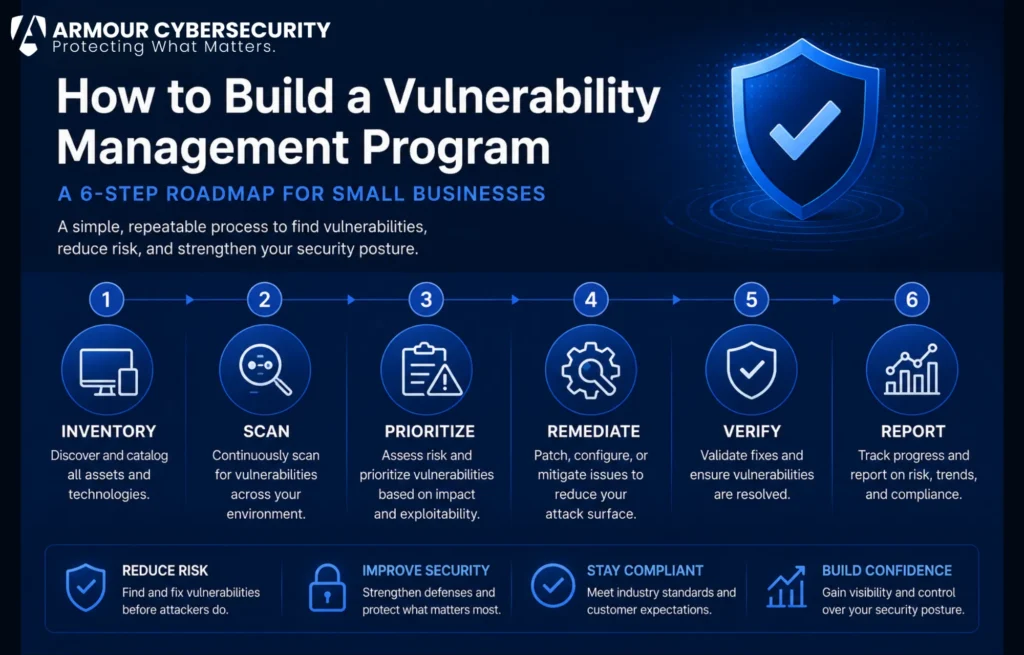
Quick answer: A vulnerability management program for a small business needs six things: an accurate asset inventory, recurring scans on a defined schedule, a prioritization method that sequences findings by real business risk, assigned remediation ownership with target dates, verification that fixes actually worked, and reporting that leadership can use. Most SMBs are missing at least three of these. A managed program delivers all six.
Key Takeaways
- The first step is knowing what you have. Asset discovery before scanning is not optional; an incomplete inventory means incomplete coverage.
- Scan frequency matters, but the cadence must be sustainable and matched to the environment’s risk profile.
- Prioritization is where most internal programs fail. Raw CVSS scores alone do not account for how critical the affected system is or whether an exploit is actively in use.
- Remediation tracking is the accountability layer. Without it, findings sit in reports indefinitely.
- Verification closes the loop. A finding is not resolved until a follow-up scan confirms it.
- Reporting translates technical findings into the language leadership, auditors, and cyber insurance carriers need.
Why Do Most Small Business Vulnerability Programs Fail?
Most SMBs that have made an attempt at vulnerability management are running a version of the same flawed process. A scanner is deployed. It runs periodically. It produces reports. The reports are distributed to IT staff who are already overloaded. Critical items get some attention. Everything else accumulates. The program does not improve month over month because there is no accountability structure, no remediation tracking, and no verification step.
The program fails not because the technology is wrong but because the discipline around it is absent. A scanner is a tool. A vulnerability management program is a process that uses scanning as one input, combined with structured prioritization, tracked remediation, and recurring governance. Building that process correctly from the start is what separates organizations that genuinely reduce attack surface from those that accumulate scan reports.
Step 1: Build an Accurate Asset Inventory
You cannot scan what you do not know exists. The first step in any vulnerability management program is establishing an accurate, current inventory of every asset in scope: servers, workstations, laptops, network appliances, cloud workloads, virtual machines, mobile devices, and any other connected system that processes or stores business data.
For most SMBs, this first-pass discovery produces surprises. Systems that were stood up by a team and forgotten. Cloud resources created for a project and never decommissioned. Devices connected to the network without IT review. Every one of these represents an asset that has been operating outside any security oversight and potentially harboring vulnerabilities for months or years.
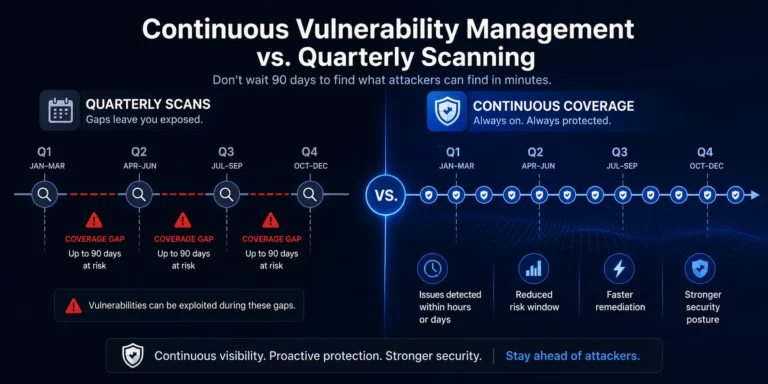
Asset discovery should be continuous rather than a one-time exercise. Environments change constantly. New systems appear, old ones are decommissioned, cloud resources are created and destroyed. A program with continuous discovery captures these changes promptly rather than letting the asset inventory drift, the same drift problem that makes quarterly scanning fall behind.
Step 2: Define Your Scanning Cadence
Once the asset inventory is established, the scanning cadence needs to match the risk profile of the environment. Not every system needs to be scanned at the same frequency. A framework for assigning scan cadence by asset category makes the program sustainable and ensures the highest-risk systems receive the most attention.
- Internet-facing systems: weekly authenticated scans minimum. These are the most exposed assets and the first target of automated attack campaigns following new CVE disclosures.
- Internal servers holding sensitive data: monthly comprehensive scans with authentication.
- End-user workstations: monthly scans, with the option to increase frequency for remote devices and high-privilege accounts.
- Network appliances and infrastructure: monthly, with configuration reviews quarterly.
- Cloud workloads: continuous asset discovery with scheduled authenticated scanning. Cloud environments change rapidly and benefit from higher frequency coverage.
Scan triggers beyond the regular schedule are also important. A significant CVE disclosed against software in your environment should trigger an ad hoc scan of affected systems rather than waiting for the next scheduled cycle. Major environment changes, such as new systems being deployed or significant configuration changes, should similarly trigger targeted scanning before the next regular cycle.
Step 3: Prioritize Findings by Real Business Risk
A comprehensive vulnerability scan of a moderately sized environment can produce hundreds or thousands of findings. The critical discipline is translating that list into a sequenced worklist that guides the team to work the right issues first rather than the loudest.
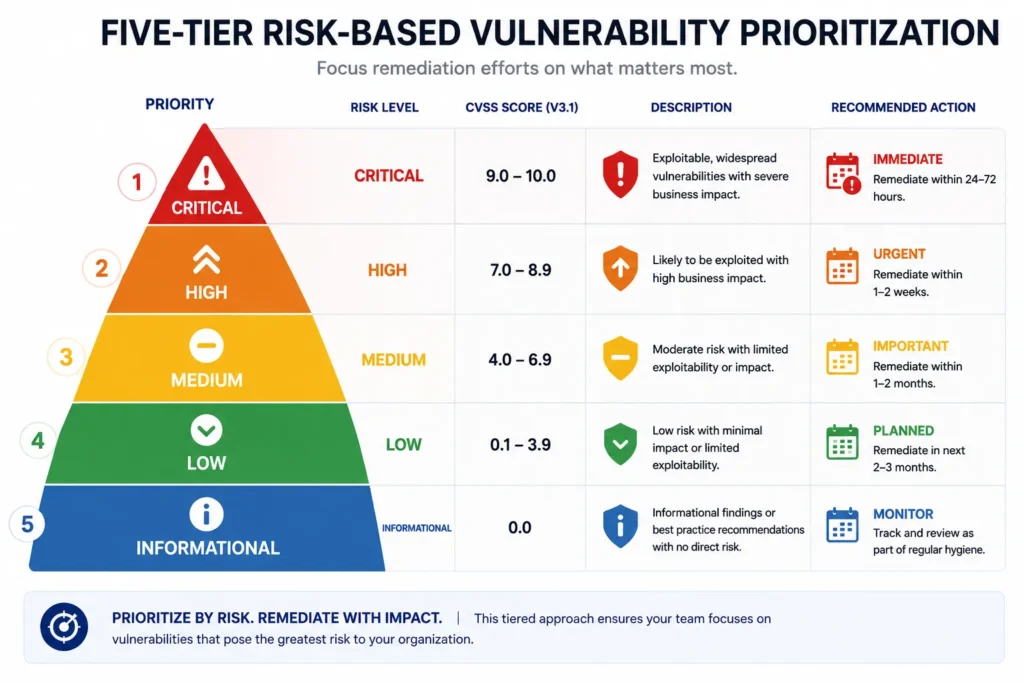
Raw CVSS scores are a useful starting point but an insufficient end point for prioritization. A CVSS 9.8 vulnerability on a system that is air-gapped from the internet and holds no sensitive data presents different risk than a CVSS 7.2 vulnerability on an internet-facing web server processing payment data. Effective prioritization layers in:
- CVSS v3.1 base score as the technical severity baseline.
- Exploit availability: is weaponized exploit code publicly available and being actively used? Current threat intelligence answers this.
- Asset criticality: how important is the affected system to business operations and data protection?
- Exposure: is the system internet-facing, accessible by third parties, or internal only?
- Compensating controls: are there other controls in place that reduce the practical risk of exploitation?
The output is a five-tier classification (Critical, High, Medium, Low, Informational) sequenced by genuine business risk. The team works this list in order. Critical and High items receive assigned owners and target remediation dates. Medium and Low items are tracked but triaged against the higher-priority work.
Step 4: Track Remediation to Verified Closure
This is the step that most informal vulnerability programs omit entirely, and it is where the most significant gap between scanning and managing vulnerabilities lives.
Every finding in the prioritized worklist should have an assigned owner, a target remediation date determined by its severity tier, and a verification requirement. The finding is not closed until a follow-up scan of the affected system confirms that the vulnerability is no longer present. Until that confirmation is received, the finding remains open regardless of what the remediation ticket says.
Open items should be aged and tracked over time. An item that has exceeded its target remediation date without closure is escalated. Leadership visibility into the aging of open items creates accountability that informal patch management processes lack. Monthly reporting on remediation velocity, items closed, items overdue, and items added during the period gives the program a measurable track record rather than an opaque status.
Step 5: Report in Language Leadership Can Use
Technical scan reports serve the team doing the remediation work. Leadership, auditors, and cyber insurance carriers need something different: a translation of the technical findings into governance language that supports decision-making and satisfies external requirements.
Monthly operational reports should cover scan coverage for the period, new findings introduced, findings remediated and verified, remediation velocity trends, and open item aging. These give the security and IT team a clear picture of program performance and create the audit trail that compliance programs require.
Quarterly executive reports translate those metrics into the language the board and senior leadership expect: overall risk posture, trend direction, comparison to prior periods, and strategic recommendations for the program. These reports are designed to be presented to leadership and distributed to auditors and cyber insurance carriers without requiring a technical interpreter.
Should a Small Business Run This Program Internally or Use a Managed Service?
The honest answer for most SMBs is that running a complete vulnerability management program internally requires resources that are difficult to justify against other priorities. A full program requires scanner deployment and configuration, continuous asset discovery, authenticated scan access across the environment, a structured prioritization methodology, a remediation tracking system, verification scanning, and recurring report production. Doing all of this well requires dedicated time from someone with the expertise to operate the tools and interpret the findings.
A managed vulnerability management service delivers the complete program without requiring the SMB to hire dedicated security staff or build the process from scratch. It covers all six steps described above, including continuous asset discovery, recurring authenticated and unauthenticated scanning, risk-based prioritization, tracked remediation with verified closure, and monthly and quarterly reporting structured for board distribution, audit submission, and cyber insurance documentation. The program runs on a defined cadence and produces deliverables that improve the organization’s security posture measurably over time.
Vulnerability management rarely works alone. It is one pillar of Armour’s managed cybersecurity services, operating alongside a managed Security Operations Center for detection, cyber threat intelligence on what attackers are actively exploiting, vCISO leadership for governance, cyber awareness training for the human layer, and the all-in-one Armour 360 managed program.
Across 260+ managed engagements in 52+ industries, the step that separates a working program from a pile of scan reports is the same one most SMBs skip: tracking remediation to verified closure.
The Bottom Line
Building a vulnerability management program is not about buying a scanner. It is about the six-step discipline around it: know your assets, scan on a sane cadence, prioritize by real risk, track fixes to verified closure, and report in language leadership and auditors understand. Do that, and you move from collecting scan reports to actually shrinking your attack surface. Armour’s managed vulnerability management delivers all six steps as a standard service, no in-house security team required.
Frequently Asked Questions
How long does it take to set up a vulnerability management program?
A: The initial setup phase, including program scoping, secure access configuration, stakeholder mapping, and baseline asset discovery, typically takes two to four weeks. The first comprehensive scan and findings report follows shortly after. The program reaches a steady operational cadence within the first 60 days, with the first monthly report delivered at the end of the initial scan cycle.
What tools are used in a vulnerability management program?
A: The tools depend on the environment and the provider. Enterprise-grade vulnerability scanners such as Tenable, Qualys, or Rapid7 are commonly used for IT environment scanning. OT environments require purpose-built tools with passive monitoring capabilities. Asset discovery may use dedicated network discovery tools alongside scanner output. Remediation tracking typically uses a purpose-built vulnerability management platform or integrated ticketing system. The specific toolset matters less than the process built around it.
What is an authenticated scan and why does it matter?
A: An authenticated scan uses valid credentials to log into the systems being scanned, which gives the scanner visibility into software versions, installed patches, and configuration settings that are not visible from an external network perspective. Unauthenticated scans identify exposures visible to someone without system access. Both are useful and most programs use both profiles. Authenticated scans typically identify significantly more findings and produce more accurate results because they can see inside the system rather than just probing its exposed surface.
How does a vulnerability management program handle new assets added to the network?
A: Continuous asset discovery identifies new assets as they appear. When a new system is detected, it is added to the asset inventory, assessed for scan coverage requirements, and included in the next scheduled scan. The organization receives notification of new assets as part of the monthly reporting cycle so that systems standing up outside the formal change management process are surfaced to IT and security leadership promptly.
What is the difference between a vulnerability management program and penetration testing?
A: Vulnerability management is an ongoing program that continuously identifies, prioritizes, and tracks remediation of known vulnerabilities across the environment. Penetration testing is a time-limited exercise where security professionals simulate attacker behavior to identify exploitable weaknesses that automated scanners may not detect. The two are complementary: vulnerability management maintains baseline hygiene on a continuous basis, while penetration testing validates that the controls in place hold up against realistic attack scenarios. Most compliance frameworks recommend or require both.
About the Author
David Chernitzky is the CEO and Co-Founder of Armour Cybersecurity, a Toronto-based firm that protects organizations across North America from advanced cyber threats. He brings more than 25 years of cybersecurity and military cyber intelligence experience, having served as an officer in an elite technology unit before co-founding Armour. Armour’s team of military-intelligence veterans and senior advisors serves 260+ clients across 52+ industries with a 97% client retention rate.