How to Build a Vulnerability Management Program for Your Small Business
Jul 31, 2026
A vulnerability management program needs six things, and most SMBs are missing at least three. Here are the steps to build one,...


A continuous vulnerability management program covering ongoing asset discovery, recurring scanning, risk-based prioritization, remediation tracking, and verification. Built for organizations that recognize point-in-time assessments leave gaps the moment they conclude. Coverage across IT and OT environments. Framework-agnostic methodology informed by leading industry standards.
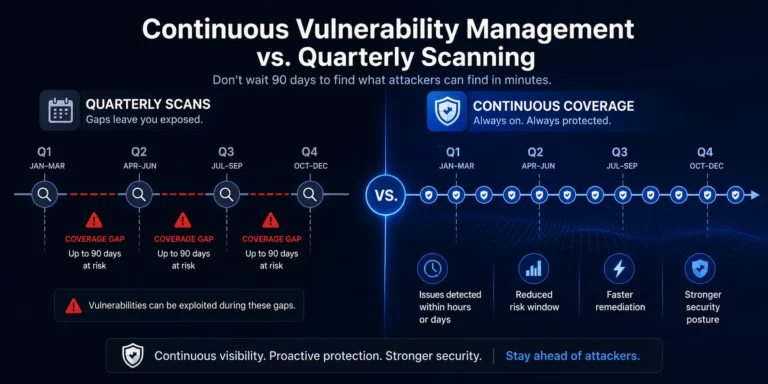
A point-in-time vulnerability assessment tells the organization where it stood on the day the scan ran. A week later, new CVEs are published. A month later, new assets have appeared on the network. A quarter later, the environment has drifted far enough that the original report is reference material rather than reality. Vulnerabilities are continuously discovered and continuously introduced. The discipline that keeps an organization secure is the one that matches that pace.
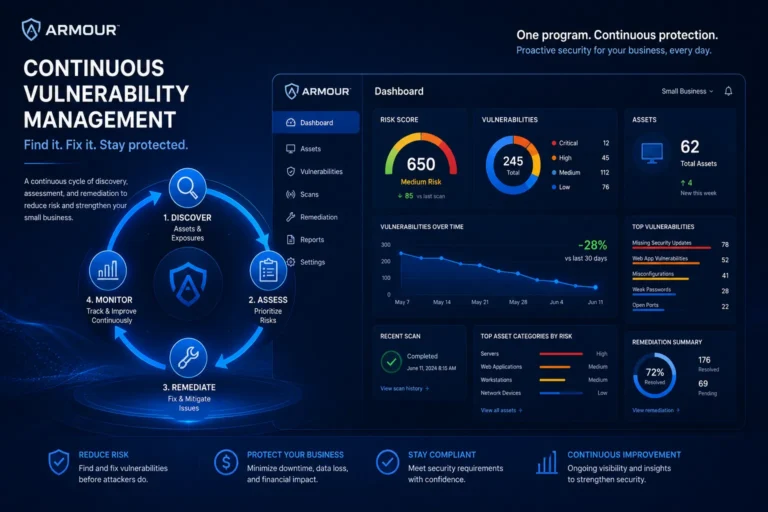
Armour Cybersecurity's Vulnerability Management service is that ongoing discipline. The program continuously discovers assets across IT and OT environments, runs recurring authenticated and unauthenticated scans, maps findings to CVE identifiers with CVSS scoring, prioritizes by exploitability and asset criticality, tracks remediation through to verification, and reports outcomes to executive leadership on a defined cadence. The deliverable is not a one-time report; it is a sustained reduction in attack surface measured month over month.
Coverage spans the full range of modern environments. IT systems including servers, endpoints, workstations, network appliances, cloud workloads, and SaaS platforms. OT systems including SCADA, PLCs, HMIs, and industrial control infrastructure, assessed with non-invasive techniques designed for legacy environments that cannot tolerate disruption. The methodology is framework-agnostic, mapped to whichever standard the organization, auditor, or carrier expects (ISO/IEC 27001, NIST Cybersecurity Framework, IEC 62443, CIS Controls v8, PCI DSS).
The difference between organizations that genuinely manage vulnerabilities and those that have a stack of unread scan reports is whether the program runs as a continuous discipline or as a sporadic compliance exercise.
The quarterly scan was completed last month. The PDF lives somewhere on the security team's shared drive. Three of the critical findings were patched. The medium and low findings were never triaged. New CVEs published since the scan are not yet on the radar. Eight new servers were stood up by the cloud team without security review. A vendor pushed a firmware update to half the OT devices last week. The organization's actual vulnerability posture has drifted significantly from what the report shows, and nobody is tracking that drift. The next scan will produce another report. The cycle repeats.
The program runs on a sustained cadence. Asset discovery is continuous, not episodic. Scans run on a defined schedule with authenticated and unauthenticated profiles appropriate to each environment. Findings are prioritized using CVSS scoring against asset criticality and exploit availability, so the team works the right vulnerabilities first rather than the loudest. Remediation is tracked through to verification and closed only when a follow-up scan confirms the fix. Monthly and quarterly reporting translates technical findings into governance language the board, auditors, and cyber insurance carriers can use.
Nine integrated capabilities that together form the continuous vulnerability management program. The same senior team operates all nine, with documentation and reporting designed to support compliance, audit, board reporting, and cyber insurance requirements.
Ongoing identification of digital assets across on-premises, cloud, endpoint, and mobile environments. Automated tools surface new assets promptly so that nothing falls outside the program.
Authenticated and unauthenticated scans of internal servers, workstations, network appliances, endpoints, and cloud workloads, run on a defined cadence with reporting on each cycle.
Non-invasive scanning of OT systems (SCADA, PLCs, HMIs, industrial control infrastructure) designed for legacy environments that cannot tolerate operational disruption.
Findings mapped to CVE identifiers, scored using CVSS v3.1, and prioritized against asset criticality and exploit availability so the team works the right vulnerabilities first.
Review of device configurations for default accounts, unnecessary services, open ports, weak protocols (e.g., outdated SMB, Telnet), and other hardening deficiencies beyond CVE-based findings.
Assessment of segmentation, firewall rules, VLAN configurations, VPN access, and third-party remote access points to identify lateral movement risks and exposure gaps.
Findings tracked through to verified closure with follow-up scanning to confirm fixes. Open items aged and reported to ensure accountability and visible progress month over month.
Review of patch and update management processes, identification of unpatched software and unsupported services, and recommendations for sustainable patching cadence.
Recurring reporting on program metrics, trends, open findings, remediation velocity, and executive-level risk posture. Tailored for board distribution, audit submission, and carrier renewal.
Built for organizations that have moved past the question of whether to scan and now need to operate vulnerability management as a sustained discipline rather than a quarterly compliance exercise.
Organizations with hundreds to thousands of assets across servers, endpoints, cloud workloads, and network infrastructure that have outgrown ad hoc scanning and need a managed program with accountability and metrics.
Manufacturing, energy, utilities, and other organizations with convergent IT and OT environments, including legacy systems that require non-invasive assessment techniques and operational sensitivity.
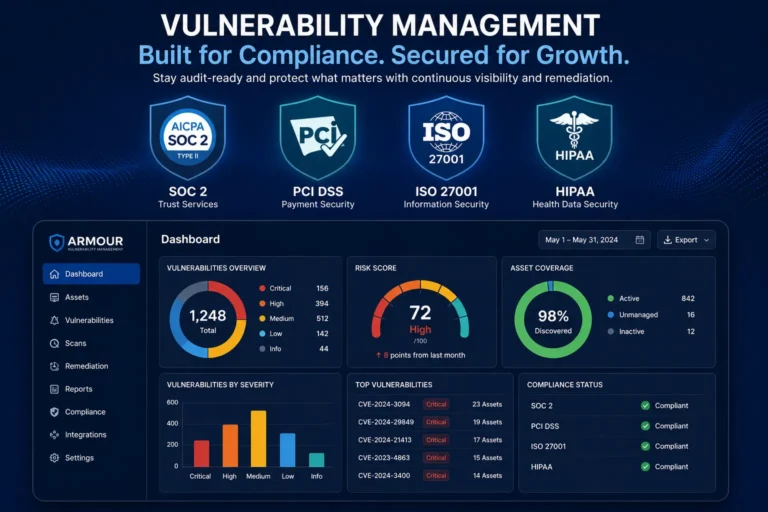
Organizations with regulatory or contractual obligations (PCI DSS, HIPAA, SOC 2, ISO 27001, NIST CSF, CMMC) that require evidence of an ongoing vulnerability management program rather than point-in-time scans.
Organizations whose cyber insurance carrier expects continuous vulnerability management with documented remediation cadence, asset coverage, and patching discipline as part of underwriting and renewal.
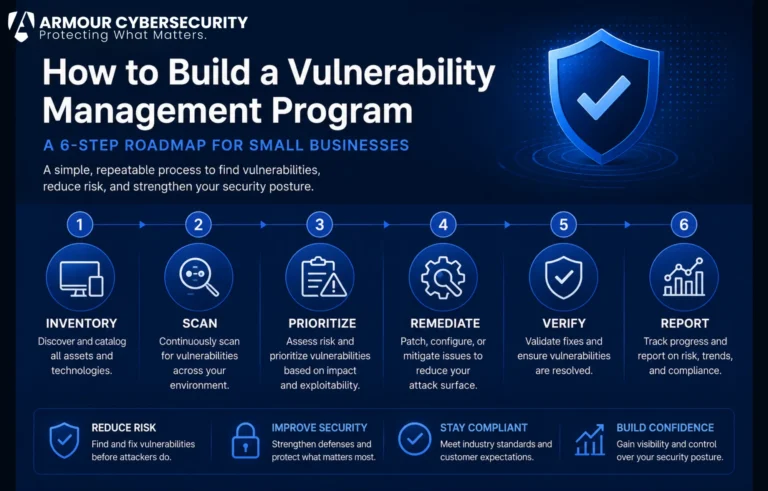
Six structured phases that operate on a continuous cycle. After initial setup and baseline, phases three through six repeat on the agreed cadence, with the program improving over each cycle.
Engagement kickoff to confirm scope across IT and OT environments, identify stakeholders, establish secure communication channels, agree reporting cadence, and define escalation procedures and access prerequisites.
Initial asset inventory across all environments. Documentation of network topology, segmentation, security controls, existing vulnerability management tools, and patch management processes. Establishes the baseline against which progress is measured.
Authenticated and unauthenticated scanning of in-scope assets. Configuration and hardening reviews. OT systems assessed with non-invasive techniques. Network segmentation, access control, and remote access configurations evaluated.
Validation of findings with false-positive removal. CVE mapping and CVSS scoring. Prioritization against asset criticality, exploit availability, and business context. Output is a prioritized worklist sequenced by genuine risk rather than scan severity alone.
Remediation worklist tracked through to closure with verification scanning. Open items aged, ownership assigned, and escalation triggered on schedule slippage. Patch and configuration changes verified before items are closed.
Monthly operational reports and quarterly executive reports covering program metrics, trends, open findings, remediation velocity, and overall risk posture. Reports structured for board distribution, audit submission, and carrier renewal documentation.
Nine integrated deliverables produced and refreshed across the program lifecycle. Each is structured to support compliance, audit evidence, board reporting, and cyber insurance documentation.
Documented asset inventory across IT and OT environments with associated network topology, refreshed on each cycle to capture new assets, decommissioned systems, and environment drift.
Recurring scan reports covering all in-scope assets with CVE mapping, CVSS v3.1 scoring, and asset-level impact analysis. Authenticated and unauthenticated scan profiles run as scoped.
Prioritized remediation worklist sequenced by exploitability, asset criticality, and business impact. Ownership, target dates, and current status tracked for every open item.
Findings beyond CVE-based vulnerabilities, covering default accounts, unnecessary services, open ports, weak encryption, insecure protocols, and other hardening deficiencies with specific remediation guidance.
Assessment of network segmentation, VLAN configurations, firewall rules, VPN access, and third-party remote access points, with recommended improvements for reducing lateral movement risk.
Dedicated OT findings report covering SCADA, PLCs, HMIs, and industrial control systems with operational impact assessment and remediation guidance tailored to legacy environment constraints.
Verification of remediated findings through follow-up scanning, with documented evidence that fixes were applied effectively and the vulnerability no longer presents on the environment.
Recurring operational reports covering program metrics, scan coverage, new findings, remediation velocity, open item aging, and trend analysis for technical and operational leadership.
Executive-level quarterly reports translating program metrics into governance language with risk heat maps, posture trends, and strategic recommendations suitable for board, audit committee, and carrier distribution.
Founded by military intelligence veterans with senior advisors from PwC, KPMG, Deloitte, EY, and Mandiant. The track record reflects the discipline.
Organizations across finance, healthcare, technology, energy, legal, and government trust Armour Cybersecurity to protect what matters.
Long-term engagements built on consistent quality, predictable delivery, and consulting relationships that compound in value over time.
Cross-sector experience spanning every major regulated industry, with operations supporting clients across North America, Latin America, and beyond.
A vetted catalogue of vulnerability scanning, configuration assessment, and remediation tracking technologies deployed across IT and OT environments to support continuous program execution.
Schedule a discovery call to scope a continuous vulnerability management program. Protecting What Matters starts with the sustained reduction of attack surface.
Book Discovery CallCommon questions from CISOs, IT leaders, compliance officers, and risk owners evaluating a continuous Vulnerability Management program.
Reach out to scope a continuous Vulnerability Management program. Discovery calls are scheduled within two business days.
Tell us about your current environment, vulnerability management posture, and what is driving the program interest. A senior advisor will respond within two business days.
Vulnerability management insights for organizations building a repeatable, risk-based program.