Quick answer: You measure the ROI of cyber awareness training by tracking behavioural metrics, not completion rates: simulated phishing click rate over time, report rate, mean time to report, repeat-clicker cohort size, and risk-score trends by role. You then translate those into board language, cost avoidance on an average phishing breach of roughly 4.9 million dollars, cyber insurance premium improvements, and reduced compliance-finding risk.
Key Takeaways
- Completion rates measure scheduling, not effectiveness. A 94% completion rate can coexist with a flat real-world click rate.
- The metrics that prove ROI are behavioural: click rate, report rate, mean time to report, repeat-clicker cohort, and risk-score trend.
- Boards think in dollars, not click rates. ROI needs a bridge: cost avoidance, insurance premium positioning, and compliance-finding avoidance.
- A quarterly executive report is the artefact that survives a CISO transition, a board change, or an insurer review.
- The average phishing-related breach costs about $4.91M (IBM 2025), which is the anchor for a defensible cost-avoidance ROI estimate.
Security awareness training is one of the most consistently underfunded and most poorly measured lines in the enterprise security budget. CISOs know it matters. Boards accept it exists. But when the question shifts from “do we have a program” to “is the program working,” most organizations go quiet.
That silence is not a measurement problem. It is a program design problem. The metrics exist. Most programs are simply not built to produce them, which is the difference between a compliance checkbox and a continuous awareness program.
Why ROI Is Hard to Measure, and How to Fix It
The core challenge is that security awareness training is a control designed to prevent events that are inherently difficult to count. You cannot easily measure phishing emails that were not clicked, business email compromise attempts that were reported before money moved, or credentials that were not entered into a spoofed login page. Prevention is invisible by nature.
This leads most programs to default to the one metric that is easy to count: training completion rates. A 94 percent completion rate sounds like evidence of program effectiveness. It is actually evidence of scheduling effectiveness. The two are not the same.
The fix is to measure what the program is actually trying to change: human behaviour under simulated threat conditions.
The Metrics That Actually Matter
Phishing click rate over time
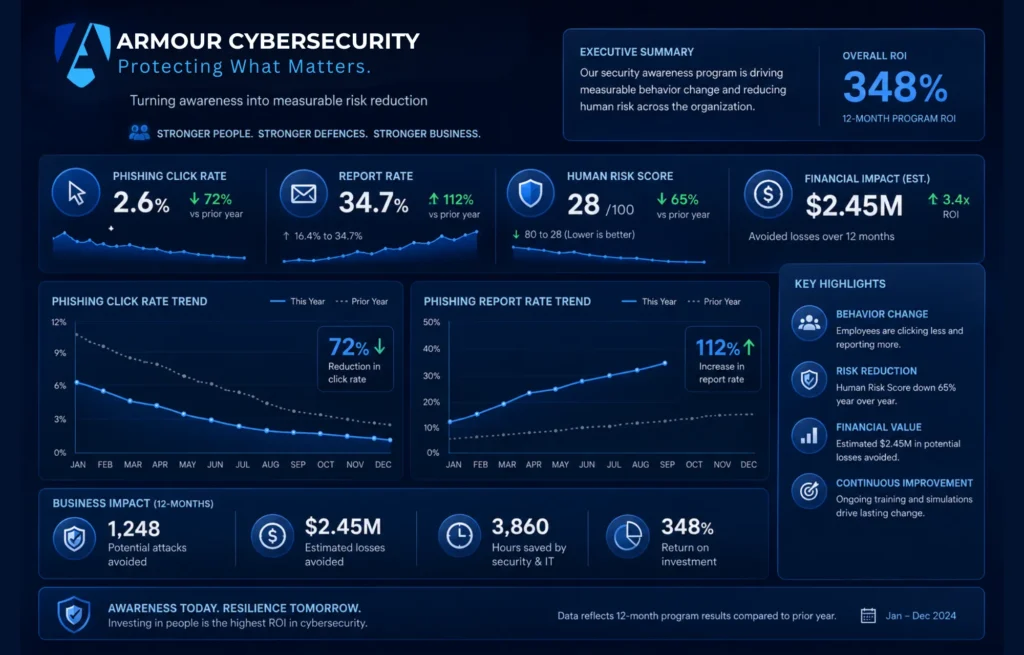
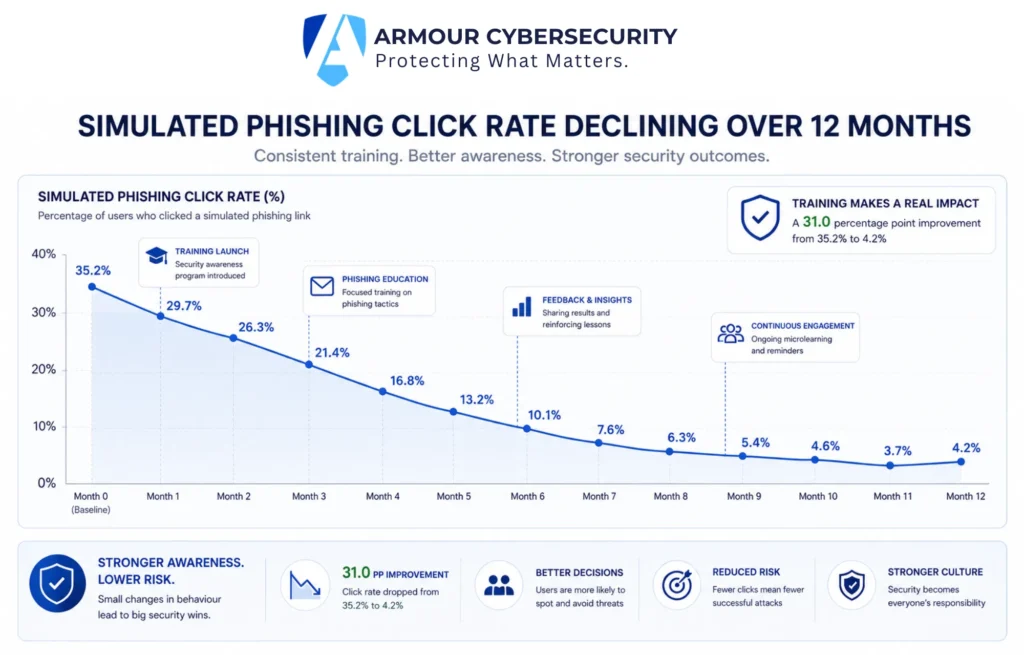
The most direct measure of awareness program effectiveness is the simulated phishing click rate, tracked monthly, across the organization and segmented by role and department. A well-run program drives this metric down over six to twelve months and holds it there. The starting click rate for organizations without continuous training typically runs between 25 and 40 percent. Programs that run monthly simulations consistently drive this below 5 percent within a year.
Phishing report rate
Click rate is a measure of failure. Report rate is a measure of active defense. Employees who recognize a suspicious message and report it through the designated channel are functioning as a human sensor layer, extending the security team’s visibility into active phishing attempts against the organization. Rising report rates are a leading indicator that security culture is changing, not just security behaviour.
Mean time to report
Beyond whether employees report suspicious messages, the speed at which they report matters. An employee who identifies a phishing attempt within minutes gives the security team a chance to pull the message from other inboxes before the campaign succeeds. Tracking mean time to report, and trending it over time, gives the program a metric that translates directly into incident response advantage and feeds the wider managed SOC picture.
Repeat-clicker rate and cohort size
In most organizations, a small percentage of employees account for a disproportionate share of simulated phishing clicks. Identifying this cohort, measuring its size over time, and tracking whether targeted intervention is reducing it is one of the most actionable metrics a security awareness program can produce. A shrinking repeat-clicker cohort is measurable, attributable risk reduction.
Risk score trend by role and department
Aggregated risk scoring across roles, departments, and geographies transforms individual behavioural data into organizational intelligence. A finance team with a rising risk score warrants different attention than an IT team with a stable trajectory. Trend lines over time tell the board a story that completion certificates cannot.
84% reduction in click rate achievable within 12 months of a continuous monthly simulation program.
3-7x higher report rates in organizations running continuous awareness versus annual-only programs.
$4.91M average cost of a breach involving a phishing attack (IBM 2025 Cost of a Data Breach Report).
Translating Metrics Into Board Language
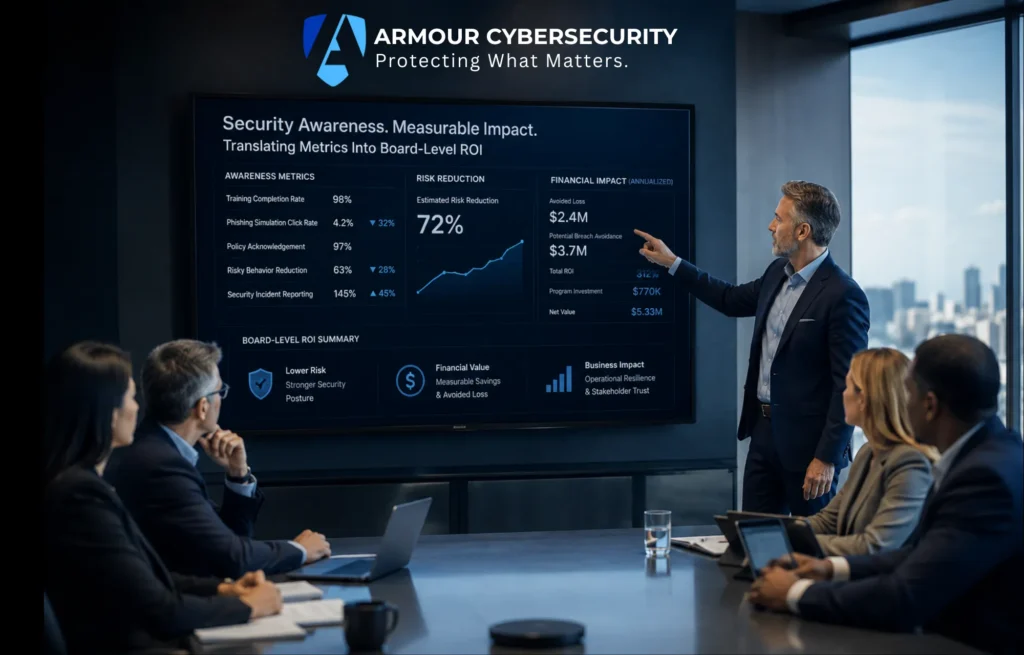
Risk reduction metrics are necessary but not sufficient for board-level ROI conversations. Boards think in dollars, liability exposure, and reputational risk, not click rates. The translation requires a bridging framework.
Cost avoidance framing
The average cost of a data breach attributed to a phishing attack now approaches five million dollars when direct and indirect costs are included. A program that demonstrably reduces phishing susceptibility is not an expense, it is a risk transfer mechanism with a measurable expected value. Framing the program’s cost against the probable cost of an avoided incident, weighted by the likelihood reduction the data supports, produces a defensible ROI estimate that finance and the board can evaluate.
Cyber insurance premium positioning
Cyber insurers are increasingly segmenting premiums based on the quality of the insured’s security awareness program. Organizations that can demonstrate continuous training, monthly simulated phishing, documented risk score improvement, and audit-ready compliance evidence are consistently offered better terms. Quantifying the premium differential is a direct financial ROI figure that requires no modeling assumptions.
Compliance cost avoidance
Regulatory fines, audit failures, and the cost of remediation following a compliance finding are measurable. An awareness program that generates continuous, audit-ready evidence for PIPEDA, SOC 2, ISO 27001, and NIST CSF reduces the probability and severity of compliance findings, the same discipline behind broader compliance readiness. The cost avoidance is the difference between walking into an audit with structured evidence and scrambling to reconstruct a program history in the weeks before the auditor arrives.
Across 260+ client engagements in 52+ industries, the awareness programs that survive a budget review are the ones with a risk-score trend to show. Completion spreadsheets get cut; documented behavioural change does not.
Building a Reporting Cadence That Holds Up
ROI evidence is only as useful as the cadence through which it reaches decision-makers. A quarterly executive report that translates operational data into risk reduction outcomes gives the board a consistent view of program performance, not a once-a-year summary of completion rates, and it is the kind of governance a vCISO is built to run.
The report structure that works covers: organizational risk score trend, click and report rate trajectory, repeat-clicker cohort size and direction, compliance evidence status, and the residual high-risk cohorts that warrant additional investment. Each metric is benchmarked against the prior quarter, the program baseline, and industry data.
That report is also the artefact that survives a CISO transition, a board composition change, or an insurer review. It documents a story of continuous improvement that a completion spreadsheet cannot tell.
The Bottom Line
Measuring the ROI of cyber awareness training is not a theoretical exercise. It requires a program designed to produce measurable behavioural data, not just completion certificates, and a reporting framework that translates that data into the language of risk, liability, and financial exposure. Organizations that build this capability find the board conversation shifts from “how much does the training cost” to “how much risk has the program removed.” Armour’s managed cyber awareness training delivers quarterly board-ready reporting with every engagement. Schedule a discovery call to discuss your measurement requirements.
Awareness training rarely works alone. It is one pillar of Armour’s managed cybersecurity services, operating alongside a managed Security Operations Center for detection, cyber threat intelligence on live adversary behaviour, vulnerability management for the technical layer, vCISO leadership for governance, and the all-in-one Armour 360 managed program.
Frequently Asked Questions
How do you measure the ROI of cyber awareness training?
A: You measure it in two layers. First, behavioural metrics that prove risk reduction: simulated phishing click rate over time, report rate, mean time to report, repeat-clicker cohort size, and risk-score trends by role. Second, a translation of those into financial terms the board understands: cost avoidance against the roughly 4.9 million dollar average phishing breach, cyber insurance premium improvements, and reduced compliance-finding risk.
Why are completion rates a poor measure of awareness training?
A: Because completion measures scheduling, not behaviour. A 94 percent completion rate tells you people finished the course, not that they will hesitate before clicking a well-crafted phishing lure months later. The same completion rate is consistent with a real-world click rate that has not improved in years. Effectiveness has to be measured through simulated-threat behaviour, not attendance.
What metrics show whether security awareness training is working?
A: The most useful are: simulated phishing click rate (tracked monthly and segmented by role), report rate (how many employees actively report suspicious messages), mean time to report, repeat-clicker cohort size and its direction over time, and aggregated risk-score trends by team and department. Together these show whether behaviour, not just completion, is improving.
How does cyber awareness training affect cyber insurance premiums?
A: Insurers increasingly segment premiums by the quality of an organization’s awareness program. Those that can demonstrate continuous training, monthly simulated phishing, documented risk-score improvement, and audit-ready evidence are consistently offered better terms. The premium differential between a documented continuous program and an annual-only one is a direct financial ROI figure that needs no modeling assumptions.
What should a board-level awareness training report include?
A: A quarterly report that covers organizational risk-score trend, click and report-rate trajectory, repeat-clicker cohort size and direction, compliance evidence status, and the residual high-risk cohorts needing investment. Each metric should be benchmarked against the prior quarter, the program baseline, and industry data, so the board sees a continuous-improvement story rather than a completion summary.
About the Author
David Chernitzky is the CEO and Co-Founder of Armour Cybersecurity, a Toronto-based firm that protects organizations across North America from advanced cyber threats. He brings more than 25 years of cybersecurity and military cyber intelligence experience, having served as an officer in an elite technology unit before co-founding Armour. Armour’s team of military-intelligence veterans and senior advisors serves 260+ clients across 52+ industries with a 97% client retention rate.