By David Chernitzky, CEO and Co-Founder, Armour Cybersecurity · Serving Toronto and organizations across Canada · Last updated August 10, 2026
Quick answer:
Cyber insurance claim documentation is the evidentiary record a breach response produces: the incident timeline, timestamped action logs, forensic investigation reports, and the decisions made along the way. Carriers pay claims the evidence supports. How an organization responds, what it captured while responding, and whether it engaged the carrier through the procedure the policy specifies all shape the outcome as much as the coverage terms do. Most of that record can only be created during the response, which is why the claim is won or lost in the first days rather than at submission.
Key Takeaways
- Carriers investigate claims by reviewing the incident timeline, the response actions taken, and whether the organization followed its own documented procedures and the policy conditions.
- Documentation captured live, covering what happened, when, what was done, and who decided it, is the foundation of the claim. Reconstructed documentation invites questions about accuracy and completeness.
- Most policies require carrier notification within a defined window of becoming aware of an incident, and late notification is among the most common causes of claim friction.
- Many policies direct the insured to panel-approved forensic vendors. Engaging a firm outside the panel without prior approval can turn into a coverage dispute over costs already incurred.
- Canadian organizations may be running three notification clocks at once: the carrier’s, OSFI’s 24-hour requirement for federally regulated financial institutions, and PIPEDA’s obligation to report to the Privacy Commissioner as soon as feasible.
This article covers the claim itself, after an incident has happened. The underwriting side, meaning what carriers check before they bind or renew coverage, is covered separately in our guide to cyber insurance incident response requirements.
What Does Cyber Insurance Cover After a Breach?
Policies vary considerably, but most comprehensive cyber policies split into two categories.
First-party costs are what the incident does to you: forensic investigation, incident response services, business interruption losses during the disruption, data recovery, ransom payment where approved, notification costs for affected individuals, and credit monitoring. Third-party costs are what it does to everyone else: legal defence, regulatory fines where insurable, and damages from claims by customers or partners.
Which of those actually applies to a given incident depends on the policy terms, the nature of the event, and whether the response met the conditions attached to the coverage. Every one of those determinations rests on documentation. What the incident was, what it cost, and whether the response followed the required procedures. Knowing that at the start of the incident rather than at submission is what lets the response be structured to support the claim instead of complicating it.
Three Notification Clocks Start at Once
Canadian organizations frequently have more than one deadline running from the same moment of awareness, and they do not share a stopwatch.
The carrier clock is set by the policy. Some require notification within 24 hours, others within 72, others within a defined number of business days. It usually starts when the organization becomes aware an incident has occurred, not when the scope is understood, which catches people out. Waiting for clarity is how a policyholder misses a window while acting in good faith.
The OSFI clock applies to federally regulated financial institutions. Under OSFI’s Technology and Cyber Security Incident Reporting advisory, a FRFI must report a technology or cyber security incident to OSFI’s Technology Risk Division and its Lead Supervisor within 24 hours, or sooner if possible. The advisory removed the earlier materiality threshold, so the definition of a reportable incident is broader than many institutions assume, and OSFI expects regular updates as more becomes known.
The privacy clock runs under PIPEDA. A breach of security safeguards has to be reported to the Privacy Commissioner as soon as feasible once it is reasonable to believe there is a real risk of significant harm, with affected individuals notified as well.
All three are fed by the same underlying evidence, and none of them waits for a complete picture. That is the practical case for a response team that captures the record while the incident is running rather than assembling it afterward.
What Do Carriers Examine When They Investigate a Claim?
Notification timing
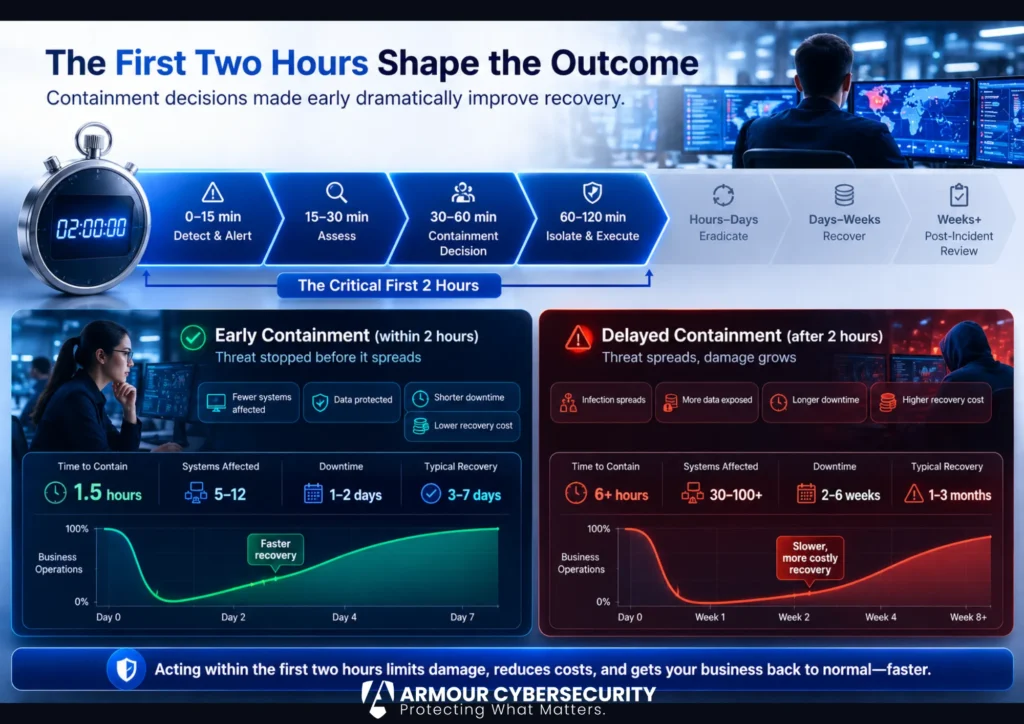
The first thing a claims investigator establishes is when the organization knew and when it told the carrier. Late notification, even when the delay was inadvertent, is one of the most common grounds for claim complications. Engaging a response team at detection should include initiating the carrier notification as part of activation, with the timing documented accurately as it happens.
Vendor engagement and the carrier panel
Many policies specify that forensic investigation and response vendors come from a carrier-approved panel, or that approval is obtained before engaging anyone else. Bringing in a firm outside the panel without that approval can create a dispute about whether the costs are covered, and that dispute surfaces after the money has been spent. Knowing the policy’s vendor requirements in advance, and confirming that the incident response retainer or emergency arrangement aligns with them, is a five-minute check that prevents a five-figure argument.
Response documentation
The claim investigation reviews the record to establish what happened, when it was detected, what data was affected, what actions were taken, and whether the response met the policy conditions. Documentation that is incomplete, internally inconsistent, or visibly reconstructed after the fact raises questions about both the incident characterization and the response itself. What holds up is timestamped action logs, investigation reports, and a post-incident report covering the full timeline.
Business interruption loss documentation
Business interruption coverage requires evidence of the financial losses during the disruption: reduced revenue, the extra cost of keeping operations running, and direct costs attributable to the incident. That evidence has to line up with the incident timeline the forensic investigation established. Carriers scrutinize these calculations, and the loss has to connect specifically to the incident period and cause rather than to general business softness that happened to coincide with it.
How Does Professional Breach Response Build the Claim File?
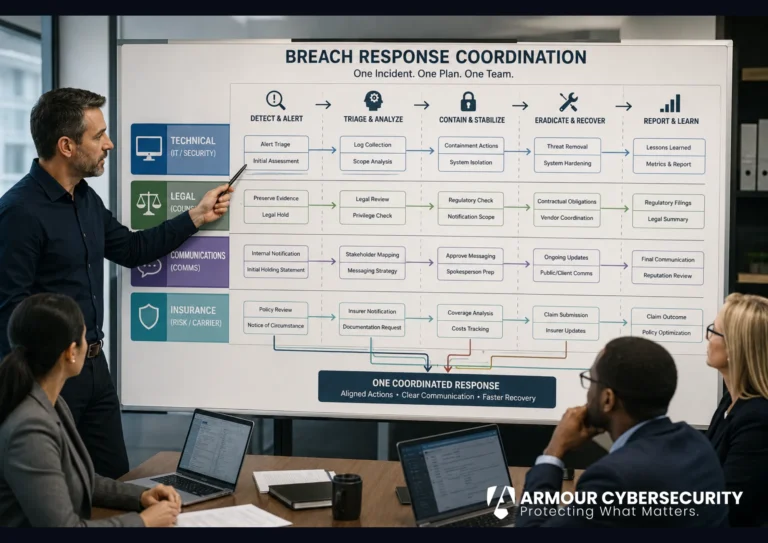
A professional response team structures its work so the documentation serves the operational response and the insurance claim at the same time. That dual purpose changes how the record is captured. Timestamps are precise. Action sequences are logged as they happen rather than reconstructed. Decision rationale is recorded next to the decision. The timeline runs continuously from detection through recovery instead of being stitched together at the end.
The investigation reports document the attack vector, the scope of compromise, the data affected, and the attacker’s tactics and tools. Those answer the exact questions a claims investigator will ask, and they establish the forensic basis for the notification determination: who was affected, what data was involved, and what the risk of harm is. Technical forensics work is what makes that determination defensible rather than estimated.
The containment plan and execution log records each action taken to stop the spread. The recovery and hardening summary records how systems were restored and what was strengthened. Together they demonstrate that the organization took reasonable and appropriate steps, which supports the claim and any regulatory inquiry into whether the response was adequate.
Communications get the same treatment. External statements coordinated through breach coach services stay consistent with what the forensic record actually supports, which matters when a carrier or a regulator later compares the public account against the technical findings.
What Happens After the Incident Closes?
The post-incident report is the final package: the timeline, the response actions, the forensic findings, the recovery steps, the lessons learned, and the recommended improvements to policy, procedure, and controls. It gets written for several audiences at once, including the internal security team, executive leadership, legal counsel, the carrier, and where applicable a regulator.
It also tends to become the foundation of the next year’s security program. The vulnerabilities exploited, the detection gaps that allowed the dwell time, and the response gaps exposed during the event all convert into prioritized work. That is the same loop the incident response lifecycle closes with, and it is where cyber insurance advisory work picks up for the renewal conversation, since the report is evidence of both what went wrong and what was fixed.
Frequently Asked Questions
What should we tell our cyber insurance carrier when we first report an incident?
Notify the carrier using the specific engagement procedure in the policy, usually a dedicated incident reporting line or email address. Provide what the initial notification requires: the date the incident was first detected, a preliminary description of what occurred, the systems affected, and the response actions taken so far. Do not speculate about scope, root cause, or liability. The initial notification establishes that the carrier was engaged within the required window, and the detailed claim documentation follows as the investigation develops.
What is a carrier-approved forensic panel and do we have to use it?
Many cyber policies provide access to a panel of pre-approved vendors for forensic investigation, breach counsel, and communications support. Panel vendors have an established relationship with the carrier and pre-negotiated billing rates. Using one is not always mandatory, but it is usually the path of least resistance for claim approval, because the carrier already knows the vendor, the rates are agreed, and the documentation format is familiar to the claims team. If you plan to use a response team that is not on the panel, confirm in advance that the carrier will approve the engagement.
Can ransom payments be covered by cyber insurance?
Ransom payment coverage appears in many policies, subject to conditions. Common ones include prior carrier notification and approval before any payment, confirmation that the threat actor is not a sanctioned entity under applicable law, engagement of carrier-approved negotiators, and documentation of the negotiation process. Paying without meeting those conditions can leave the payment uncovered. The decision to negotiate or pay should be made with breach counsel and the carrier involved, never unilaterally.
How does an incident response retainer interact with the insurance claim?
A retainer client activating the response team brings a pre-established relationship, a documented engagement scope, and a known vendor to the claim. If that vendor is on the carrier panel or has been pre-approved, the process simplifies: the carrier already knows who is doing the work, what the rates are, and what documentation to expect. The onboarding documentation created before the incident also establishes the baseline context for the forensic investigation, which supports the accuracy of the scope determination the claim rests on.
What is the most common reason cyber breach claims are disputed or reduced?
Four patterns account for most of the friction: late carrier notification, engaging non-approved vendors without prior consent, documentation gaps that make the full scope of the incident or the completeness of the response impossible to establish, and business interruption calculations that cannot be tied specifically to the incident period and cause. A professional response team addresses each one directly, by initiating carrier notification as part of activation and producing timestamped documentation throughout rather than assembling it afterward.
The Bottom Line
An insurance claim is a documentation exercise conducted under the worst possible conditions, and almost none of the required evidence can be created after the fact. The organizations that recover their costs are the ones whose response team was capturing the record from the first hour, engaging the carrier through the right channel, and working within the vendor terms the policy already set. Everyone else discovers the requirements while trying to satisfy them retroactively. Armour Cybersecurity’s breach response services produce the documentation package to carrier standard as a byproduct of the response, not as a separate exercise afterward.
About the author
David Chernitzky brings over 25 years of deep cybersecurity and military cyber intelligence experience, with a career rooted in strategic risk management and protecting critical systems against advanced threats. As the driving force behind Armour Cybersecurity, he has guided the company’s growth into a trusted global security partner for enterprises and small-to-midsized organizations.